Home » Articles posted by edzarenski (Page 26)
Author Archives: edzarenski
Behind The Headlines – Construction Data
12-2-16
Just a few important facts here (that you won’t read in the headlines).
- Jobs have increased by 23% since the recession bottom January 2011. Construction spending has increased 52% in same period.
- Adjusting jobs for hours worked and spending for inflation, both work output and constant volume construction grew at 28% since recession bottom.
- Residential construction jobs are down 22% from the 2006 peak. In constant $ after inflation, real residential volume of work is down 39%.
- Nonresidential buildings construction jobs are down 8% from the 2008 peak. In constant $ after inflation, real nonres bldgs volume of work is down 17%.
- Construction spending average for the last 3 months is at a 10 year high. Construction volume in constant $ after inflation is still 18% below 10 years ago.
- Census construction data is ALWAYS revised in the following two months after initial release. Census updates all the values for the previous year, usually with the May data release (on July 1) the following year.
- In 2016, 7 times the first release of spending showed a decline vs the previous month. After revisions, the values show no declines vs the previous month.
- In the last 36 months, there were 16 spending releases that originally showed a decline vs the previous month. After revisions there were no mo/mo declines.
- It’s hard to add $100 billion in new construction spending in one year. Since 1993 it’s happened only 3 times; 2004, 2005 and 2015.
- It’s real damn hard to add $100 billion in new construction volume in a year. After adjusting for inflation, construction volume has never increased by $100 billion. It has increased by $75 billion 4 times and 3 more times by $50 billion.
- It takes about 6,000 jobs to put-in-place $1 billion of construction in a year. $100 billion in new work would require 600,000 new jobs in a year. The largest construction jobs growth ever recorded is about 700,000 jobs in 2 years.
- Now think of #9, #10 and #11 in terms of ONLY the Infrastructure sector. Infrastructure, about 25% of total construction spending, added spending more than $25 billion in a single year only once. The average annual growth for the past 20 years is less than $10 billion/year. The average growth in jobs (excluding all recessionary years because they would make the result approach zero) is about 25,000/year.
- The Aug-Sep-Oct 3mo average of construction starts for Nonresidential Bldgs (by Dodge Data) is the best 3mo since Q1 2008. Q1 2008 was the PEAK of the nonresidential buildings construction boom.
- More infrastucture projects started construction in the 1st 6mo of 2015 than any time in history. This will boost infrastructure spending through 2017. Infrastructure spending is low in 2016 due to a low volume of starts in 2014.
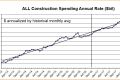
Construction Spending Oct 2016
12-1-16
October construction spending put-in-place was released today by U.S. Census. This report includes the first revision to September data and the 2nd revision to August.
LINK TO U. S. Census October Construction Spending Release 12-1-16
October spending 1st release came in at $1.172 billion, 0.5% higher than September which was revised up 1.4% to $1.166 billion from the 1st release of $1.150. August was revised up 2.1% to $1.166 billion from the 1st release of $1.142.
I predicted October spending would come in at $1.190 billion. Once revisions to October data are posted in Nov and Dec, we may reach that $1.190 billion forecast. Revisions have averaged over 1.4%/mo this year and 1.5%/mo for the last 4 months.
Average spending for the last 3 months is $1.169 billion, the highest three-month average since May-Jun-Jul 2006.
Year-to-date (YTD) spending is up 4.5% over last year, but this may go even higher once the revisions are in. There is now no doubt that we’ve clearly passed a previously forecast dip in spending that bottomed in Apr-May at $1.142 billion. The last 5 months of spending are all up from the low point and the trend is pointing higher.
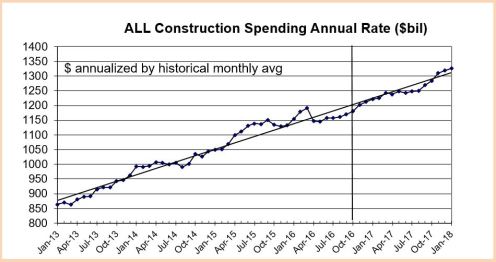
My forecast for total spending in 2016 is $1,168 billion, up 5% from 2015. I expect 7.6% growth in 2017.

MAJOR SECTORS
Residential spending is up 5.5% ytd and is on track to reach a 2016 total of $468 billion, +6.4% over 2015. Last year, peak spending was in September, then residential spending dropped slightly in Q4 2015. This year I expect 2016 spending to peak in Q4, so we should see ytd performance get better as we approach year end. Cash flow from new starts indicates growth of 9% in 2017 spending.
Total Nonresidential spending is up 3.8% ytd, on track to finish 2016 with total spending at $700 bil, up 4.2% over 2015. Almost all the 2016 growth is in nonresidential buildings, not infrastructure. For the 4mo period Jul-Oct 2016, compared to the same 4mo in 2015, all nonresidential spending is up only 1.7%, but the spending trends are not apparent unless we separate nonresidential buildings from non-building infrastructure. For Jul-Oct 2016, compared to the same period a year ago, nonresidential buildings spending is up 7.6% and non-building infrastructure is down 5.4%.
Nonresidential Buildings spending is up 8.2% ytd through October, led by Office, Lodging and Commercial Retail markets. We should finish 2016 up 8.1% with a total at $409 billion vs. $379 billion in 2015. Total sector growth for the last three years is 35%. I’m predicting 2017 spending for Nonresidential Buildings will increase 7.5%, led by Educational and Office spending.
We are currently at what may be 2016 peak nonresidential buildings spending. I’m expecting nonresidential buildings spending to stall or drop 1.5% to 2% over the next few months before resuming growth. This drop may be in large part due to uneven starts from the end of 2014 and beginning of 2015, a period when starts were abnormally high, that are now finishing and dropping out of the monthly spending values. Usual normal growth patterns in starts do not fill the void left when abnormally high volume of projects finish.
Non-building Infrastructure spending is down 1.2% ytd. Infrastructure spending in 2016 will total $291 billion, down less than 1% from 2015. Spending predicted from Dodge Data Starts predicted this drop. Negative drivers are Transportation, contributing -0.9% to overall decline, Sewage/Waste Disposal -1.0% and Water Supply -0.4%. Power, the largest infrastructure market at 33% of total, is up 1.4% ytd so adds about +0.5% to offset some of the declines. Highway/Street, 31% of infrastructure, is up only slightly. Growth resumes in Q1 2017. Although new starts in 2016 will finish down 10%, starts in 2015 were so high that 2016 will still be a good volume of new starts. Predicted spending from starts is indicating 2017 will be a record year for spending on infrastructure, up 7% from 2016.

PUBLIC MARKETS
Public spending is down 1.5% ytd, on track to finish 2016 with total spending at $285 billion, down 1.4% from 2015. Public spending will rebound in 2017, up 6.5%.
Educational spending is 80% public and 20% private. Education accounts for 25% of public work. Educational is by far the largest building type in public work. All the remaining building types contribute only 2% to 4% each.
60% of all public work is infrastructure. Highway/Street accounts for 31% of all public work. Transportation facilities is 11% of public work, Sewage and Waste Water 9% and Water 4.5%.
The biggest drivers of performance in public markets by far are Highway/Street and Educational spending. Highway/Street spending reached all-time highs from Dec 2015 to March 2016 but is currently 10% below that level and will end 2016 down 1% from 2015. In public markets educational is only up 5% ytd, but in October experienced the largest monthly increase in the public sector.
REVISIONS AND YEAR/YEAR COMPARISONS
Census construction data is always revised in the following two months after initial release. Census revises data and incorporates more data from additional sources to update spending values. Census updates all the values for the previous year, usually with the May data release (on July 1) the following year.
For the 1st nine months of 2016, seven of nine times the first release of spending showed a decline vs the previous month. After revisions, the values show no declines vs the previous month. The last 36 months of data shows there were 16 Census releases that originally showed a decline vs the previous month. After revisions there were no mo/mo declines in the last 36 months. Revisions in 2016 have averaged 1.4%/mo and 1.5%/mo for the last 4 months.
In 2015, spending peaked in the months of July, August and September, then dropped slightly and remained flat for the last quarter of the year. This 2015 pattern, along with the issue of revisions noted above, is one of the reasons comparisons of 2016 to same month last year was low for August and September. A growth trend is now in place. Expect this month vs same month last year for the remainder of 2016 to come in near or above +5%.
RELATED POST
10-20-16 Starts Point to Robust 2017 Spending
Saturday Morning Thinking Outloud #4 -YTD
11/26/16
In 2015, nonresidential buildings starts were very high in the beginning of the year and dropped off in the later part of the year. In 2016 it’s just the opposite. This skews year-to-date total comparisons and for most of this year makes it appear as if there may be no growth in new starts.
Here’s a simple example:
Let’s say 4 months in 2016 had starts of $6, 8, 10 and 12 billion and the same months in 2015 had starts of $10, 9, 8 and 7 billion. The year-to-date change for 2016 vs 2015 after the 1st month (6 vs 10) is down 40%. After two months it’s 14 vs 19 (6+8 vs 10+9), down 26%. In the 3rd month 2016 has better performance than 2015 (10 vs 8), but the year-to-date (24 vs 27), down 11%, is still strongly influenced by the earlier months. But in the 4th month we get 36 vs 34 and finally the year-to-date shows 2016 growth of 6% over 2015. That is the current scenario.
Construction Starts for nonresidential buildings for the 1st 4 months in the 2nd half of 2016 (Jul-Oct) are 30% higher than the average of the 1st half 2016 and almost 40% higher than the same 4 months in 2015, and yet the year-to-date % change 2016 vs 2015 is ZERO.
To keep from being misdirected, year-to-date comparisons require knowing not only the direction of the current year trend but also the direction of the previous year trend.
The most recent 3 month (Aug-Sep-Oct) average of nonresidential buildings construction starts by Dodge Data represent the best 3 months since Q1 2008. Although year-to-date performance of zero growth would seem to indicate a slow down, starts are doing just fine. I’m forecasting the final two months of the year to be up 40% from 2015.
But wait, there’s more!
Every year, starts from the previous year are adjusted, always higher. 2016 starts won’t be adjusted up until 2017. But that means all current 2016 (un-adjusted) starts are being compared to 2015 that has already been adjusted up. This causes the year-to-date comparison to be always understated. The average adjustment to nonresidential building starts for the last few years has been about +5%. If that trend remains consistent then next year we should see that 2016 starts were approximately 5% higher than first posted and growth was really much better than current values would seem to indicate.
With 10 months of data in hand, year-to-date starts for nonresidential buildings show no change from 2015. However starts are doing very well and I’m predicting the 2016 volume of starts will lead to 8% growth in spending in 2017.

Saturday Morning Thinking Outloud #3 – Construction Jobs
Why the big slow down in construction jobs this Year? Is work volume on the decline? Are labor shortages to blame?
These days, the most talked about reason for slower jobs growth is the lack of experienced workers available to hire. In fact, recent surveys indicate about 70% of construction firms report difficulty finding experienced workers to fill vacant positions and the Job Openings survey has been at highs for several months. That certainly cannot be overlooked as one reason for slower jobs growth, but that is not the only reason?
Although recent growth has slowed, even with all this talk of difficulty finding experienced construction workers, there has been very good jobs growth. For the 5 ½ year period from the low point in January 2011 to the present (August 2016) we added 1,240,000 construction jobs.
- Jobs increased by 23% in 5 ½ years.
- Spending growth increased 52% in that same 5 1/2 years.
Why is it that jobs don’t increase at the same rate as construction spending? Because much of that spending growth is inflation, not true volume growth. Volume is construction spending minus inflation. To get volume, convert all dollars from current $ in the year spent into constant $ by factoring out inflation.
- Spending growth is not a true measure of increase in real volume.
- Jobs growth should not be compared to spending growth.

Now that we have spending converted to volume, we need to adjust jobs to get real work output. The total hours worked affects the entire workforce so has a significant impact on output.
- Jobs is not a true measure of work output.
- Jobs x hours worked gives total work output.

Spending must be factored to remove inflation and jobs should be factored to include any change in hours worked.
- In the 5 1/2 years from Jan 2011 to mid 2016, real construction volume and jobs/hours real output both increased by 28%.
Now we see over the long term, job/hours and real volume are moving in tandem. But there are always short term periods when they do not and that causes ups and downs in productivity.
In 2014-2015, jobs/hours grew by 11%, the fastest growth for a two-year span in 10 years. Real volume of work increased by 16% producing a real net increase in productivity. But productivity had declined significantly in 2010 and 2011. It’s not unusual to see productivity balancing out over time. In part, this is due to companies balancing their total employees with their total workload.
From October 2015 through March 2016, jobs growth was exceptional. 214,000 construction jobs were added in 6 months, topping off the fastest 2 years of jobs growth in 10 years. That is the highest 6-month average growth rate in 10 years. That certainly doesn’t make it seem like there is a labor shortage. However, the jobs opening rate (JOLTS) is the highest it’s been in many years and that is a signal of difficulty in filling open positions.
- For the 6-month period including Oct’15 thru Mar’16 construction gained 214,000 jobs, the fastest rate of consecutive months jobs growth in 10 years. Then, after 3 months of job losses, July, September and October show modest gains.
I would expect growth such as we’ve had for two years and then that 6 month period to be followed by a slowdown in hiring as firms try to reach a jobs/workload balance. It appears we may have experienced that slowdown. Jobs declined for four of five months from April through August. Keep in mind, this immediately follows the fastest rate of jobs growth in 10 years. But it also tracks directly to three monthly declines in spending. (I predicted this jobs slowdown in my data 9 months ago. I predicted the 1st half 2016 spending decline more than a year ago).
It is not so unusual to see jobs growth slowed for several months. It follows directly with the Q2 trend in spending and it follows what might be considered a saturation period in jobs growth. The last two years of jobs growth was the best two-year period in 10 years. It might also be indicating that after a robust 6 month hiring period there are far fewer skilled workers still available for hire. The unemployed available for hire is the lowest in 16 years.
If spending plays out as expected into year end 2016, then construction jobs may begin to grow faster in late 2016. However, availability could have a significant impact on this needed growth.
Availability already seems to be having an effect on wages. Construction wages are up 2.6% year/year, but are up 1.2% in the last quarter, so the rate of wage growth has recently accelerated. The most recent JOLTS report shows we’ve been near and now above 200,000 job openings for months. With this latest jobs report, that could indicate labor cost will continue to rise rapidly.
As wages accelerate, also important is work scheduling capacity which is affected by the number of workers on hand to get the job done. Inability to secure sufficient workforce could impact project duration and cost and adds to risk, all inflationary. That could potentially impose a limit on spending growth. It will definitely have an upward effect on construction inflation this year. If work volume accelerates, expect labor cost inflation to rise rapidly.
Saturday Morning Thinking Outloud #2 – Headlines
11-5-16
I publish a lot of analysis for various construction data. I also read many other articles posted by other pundits in the industry, including MSM news sources. What I would say regarding construction data is this; an informed knowledge of construction data and how it’s used helps you understand if some article you are reading is accurate or relevant.
What I try to do here is not only report on the latest significant construction data, but also explain how the data must be used to make accurate and valuable analysis.
Here’s just three examples of how news analysts get it wrong:
> Post new construction starts as if those numbers represent construction spending.
A new start this month worth $10 billion adds a huge amount to the starts this month and will most certainly drive up the mo/mo and yr/yr starts numbers. But that new project could take 24 or 36 or 48 months to complete, so we can’t discern the impact on spending until we cash flow the value of the project which gives us the spending over its complete life span. In any given month the total amount of all spending is the summation of the spending this month from all the projects still ongoing that have started in previous months. Spending next month is 95% dependent on the flow of projects that started over the last 24 or 36 months.
> Suggest that two to three months of declines in spending indicates a downturn.
One of the biggest factors that determines spending this month is the values contributed this month from all the previous starts not yet completed. In a sector such as nonresidential buildings, in which the average duration of a project might be 24 months, the amount of spending this month gets some contribution from projects that started in each of the previous 24 months. One of the greatest influences on spending in any given month is the fluctuation (which could have occurred many months ago) in the amount of starts. So sometimes when we see a monthly spending dip it has nothing to do with a current declining trend in overall spending, but might have more to do with erratic new starts up to 18-24 months ago.
Starts can be quite erratic. Although we might see annual starts climbing at a modest rate of 6% or 7% per year, within that year we might see starts increase or decline by 50% or 100% from month to month. This is normal. But what it does to spending, particularly when a very large volume of project spending (from some month in the past that had huge new starts) finishes and drops out of the current spending, it causes dramatic fluctuations from month to month. Much of what we see in month to month changes in spending was predetermined months ago by the pattern of starts.
Normal rates of new starts, if always constant in growth rate, would create a constant rate of growth in spending. Erratic rates of change in starts create erratic changes in spending when those projects come to an end.
> Compare current $ this year to any $ from years past, without taking inflation into consideration.
I recently read an article that claimed construction was back to pre-recession levels. What really was being identified in that article was that current 2016$ were back to the level of current 2006$. That’s like saying $100 today buys you the same products that $100 bought you in 2006. I bet it wouldn’t be too hard to find a few examples where that would not be true.
Comparisons of dollars over time almost always need to be made using constant dollars, that is, adjusted for inflation and all converted to the same point in time, usually today. Sure spending today is up more than 50% off the bottom and in current dollars is higher than the previous peak in 2006. But if we adjusted those 2006$ for inflation the dollars spent in 2006 would be worth much more today. Although current dollars are now higher than any time in the past, after adjusting for inflation we are still 18% below peak spending.
Construction Spending Sept 2016
11-1-16
September data for construction put-in-place was released today. Year-to-date (YTD) spending is up 4.4% over last year. With September first data release at $1,150 bil SAAR, this seems to establish that we’ve clearly passed a forecast dip in spending that bottomed in April and May. We’ve now had 4 months of spending up from the previous quarter and all up from the same respective months in 2015.

One thing that stands out in the data; so far every month in 2016 construction spending has been revised upwards after the first data release, by an average of +1.2%. Checking back to Jan 2014, all but once spending was revised up after the first number released.
For the 1st eight months of 2016, six of eight times the first comparison of spending showed a decline this month vs previous month. After revisions, the final values show only one month/month comparison was down.
June data which appeared quite low at first has now been revised up by +1.8% (+$21bil saar), with most of the June revision in nonresidential buildings. Most of the July revision was to residential spending. The last three months of construction spending on average have been revised up by +1.5% each.
So, even though the first print shows September down -0.4% from August, historical data would indicate we could expect September to get revised up, perhaps by 1%+ which would result in September finishing higher than June, July or August. Of course, there is always the chance it might get very little increase, and August could still get revised.
Residential spending is up 5.7% ytd and is on track to finish 2016 at $470bil, +6.6% over 2015. Last year, peak spending was in September, then residential spending dropped slightly in Q4 2015. This year I expect 2016 spending to peak in Q4, so we should see ytd performance get better as we approach year end. Cash flow from new starts indicate growth of 9% in 2017 spending.
Total Nonresidential spending is up 3.6% ytd, on track to finish 2016 at $700 bil, up 4.2% over 2015. Almost all the 2016 growth is in nonresidential buildings, not infrastructure.
For the 3rd quarter 2016, compared to the same quarter in 2015, nonresidential spending is up only 1%, but the spending patterns are not apparent unless we separate nonresidential buildings from non-building infrastructure.
For the 3rd quarter 2016, compared to a year ago, nonresidential buildings spending is up 7% and non-building infrastructure is down 6%.
Nonresidential Buildings spending is up 8% ytd through September, led by Office, Lodging and Commercial Retail markets. We should finish 2016 up 8% with a total at $410 billion vs. $379 billion in 2015. Total sector growth for the last three years is 35%. I’m predicting 2017 spending for Nonresidential Buildings will increase 8%, led by Educational and Office spending.
The market share percent of total nonresidential buildings for each market is:
educ=22%, mnfg=19%, comm=18%, offc=17%, hlthcr=10%, lodg=7% and amus/rec=5%.
Office construction spending 2016 growth will be 20%+, now greater than 20%/yr for three consecutive years. At 17% market share, by far it is the largest contributor to nonresidential buildings spending growth in 2016, contributing +3.7% growth.
Lodging is expected to finish 2016 up 26% and has averaged greater than 25%/yr growth for four years. But lodging has only 7% market share, so contributes only +1.8% growth to nonresidential buildings.
Commercial Retail is up 9% with 18% market share and so contributes +1.6% to overall nonresidential buildings growth. For the three-year period 2012 to 2014, commercial averaged 14% growth.
Educational spending, up 5% at 22% of the market, contributes +1.1% to overall nonresidential buildings growth in 2016. Educational spending should finish 2016 up 6%.
Manufacturing buildings present a unique situation in 2016. Manufacturing is down -2.4% ytd. At 19% market share, that reduces total nonresidential buildings growth by -0.5%. On the surface, manufacturing is lowering total nonresidential buildings growth. Although manufacturing spending is down, it’s still very high, so it’s impact should not be viewed as negative to the overall sector. Spending increased 50%+ in 2014 & 2015. Spending in 2016 will still be the 2nd highest year on record, down only slightly from 2015 but still more than 30% higher than 2014 and more than 50% higher than 2013.
Educational spending is 80% public and 20% private. In public markets educational is only up 4% ytd, but in private markets it’s up 10%. Private spending is driving total educational to $89 billion for 2016, up 6% from 2015. 2016 will be the best year since 2008. 2017 may reach 7% to 8% growth.
60% of all public work is infrastructure. Education accounts for 25% of public work. Educational is by far the largest building type in public work. All the remaining building types contribute only 2% to 4% each.
We are currently at what I expect could be the 2016 nonres bldgs spending peak, with very little gains across Jul-Aug-Sep-Oct. Nonres bldgs spending may flatten or drop for several months before resuming the climb. This drop may be in large part due to uneven starts from the end of 2014 and beginning of 2015, a period when starts were abnormally high, that are now finishing and dropping out of the monthly spending values. Usual normal growth patterns do not fill the void left when abnormally high volume of projects finish.
Nonbuilding Infrastructure spending is down 1% ytd. Cash flows from starts predicted this drop. The biggest negative drivers are Transportation, Sewage/Waste Disposal and Water Supply, each contributing more than 0.5% to the total decline. Power, the largest infrastructure market at 33% of total, is up 4% ytd so adds +1.33% to growth, tempering some of the declines. Spending in 2016 will reach $292 billion, down less than 1% from 2015. Growth resumes in Q1 2017.Although new starts in 2016 will finish down 10%, starts in 2015 were so high that 2016 will still be a good volume of new starts. Cash flows from all existing starts are predicting 2017 will be a record year for spending on infrastructure, up more than 6% from 2016.
My forecast for total spending in 2016 is $1,170 billion, up 5% from 2015. I expect 8% growth in 2017.
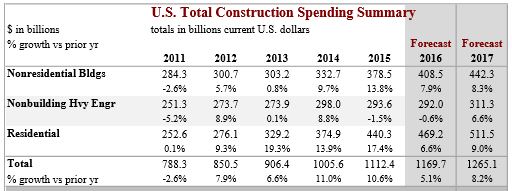
U S Census September Construction Spending Released 11-1-16
See also this post from October Starts Point to Robust 2017 Spending
Saturday Morning Thinking Outloud #1 – Infrastructure
10-29-16
Can the construction industry even accommodate adding $1 trillion of new infrastructure spending over 10 years?
It takes about 5000-6000 new jobs to support $1 billion of new construction work for a year. For infrastructure the number is lower. So $100 billion per year continuous for next 10 years would support about 400,000 new jobs for 10 years. Well, that’s not how it will happen, so let’s look a little closer.
- Historically the fastest rate of growth in spending takes about 3 years to increase 50%. That is for selected markets, never for the entire industry.
- Infrastructure spending grew 50% in 4 years from 2004 to 2008, when that sector was half the size what it is today.
- Infrastructure, about 25% of total construction spending, added spending more than $25 billion in a single year only once. The average annual growth for the past 20 years is less than $10 billion/year.
- Historical growth in jobs rarely exceeds 300,000 new jobs per year. It has never averaged that rate of growth for more than a 3 year stretch. That is for the entire industry.
- Spending after inflation (real volume growth) for all construction increased an average of $50 billion per year for the last 4 years. The same is expected in 2017.
- Jobs increased an average of 250,000 per year for the last 4 years.
- We could expect approximately the same growth in volume and jobs in 2018.
So here’s what we know. The entire construction industry has been growing on average at about $50 billion in volume and 250,000 jobs every year in recent data. Even with the addition of a new influx of infrastructure work, most of that other growth is not going to go away. But how much growth can the entire industry accommodate without bursting at the seams. Let’s make some broad assumptions to see what happens.
Let’s assume for the next 10 years the normal rate of new construction growth gets cut in half. In reality it probably wouldn’t, but we need to push some numbers to extremes to see what happens. So normal new volume, not including any boost from new federal infrastructure spending, might only grow at $25 billion per year and that would absorb 100,000-125,000 new jobs per year. That accounts for HALF of the entire industry volume growth and jobs growth. How much room does that leave for new growth or expansion in industry growth rates?
If we fill the difference with work from added new infrastructure spending, we can add $25 billion per year in new infrastructure spending and that will add about 100,000 new jobs per year. To account for how the work might be contracted out, let’s just assume in the first year we commit to $250 billion in contracts that are spread over 10 years to get to $25 billion a year in spending. In the 2nd, 3rd and 4th years we could also commit each time to another $250 billion in 10 year contracts that spread the spending out to $25 billion per year for 10 years.
By year 4, we’ve added $100 billion per year in new spending that will stretch out for the next 6 to 10 years ( note: this pushes spending $1 trillion out to 13 years). This spread of money over time, or cash flow, results in increased spending in the government infrastructure markets by 50% in 4 years, matching the best ever industry growth rates. We’ve increased jobs by 100,000 per year for 4 years to a total of 400,000 new jobs and they will all have funds to continue work for the next 6 to 10 years. All that just due to added infrastructure spending.
But let’s not forget the rest of the industry. This would push total spending growth and total industry jobs growth to the highest rates of growth on record. So this is a scenario that is unlikely to be achieved, and it’s not very likely that growth like that could be sustained for very long. It’s also not likely the rest of all the new growth in the industry is going to get cut in half to leave room for new added infrastructure work. So, it’s possible total growth over the next 4 years would be less than anticipated here. This allows for no downturn at any time in the next 10 years.
It begins to seem like it might be pretty difficult to add $1 trillion in spending to the infrastructure construction sector, which is only 1/4 of the entire industry, to be spent in the next 10 years.
When sometimes we push numbers to extremes just to see what happens, we get an unexpected picture of what might, or might not, be possible.

Construction Inflation >>> LINKS
- 10-24-16 Originally posted
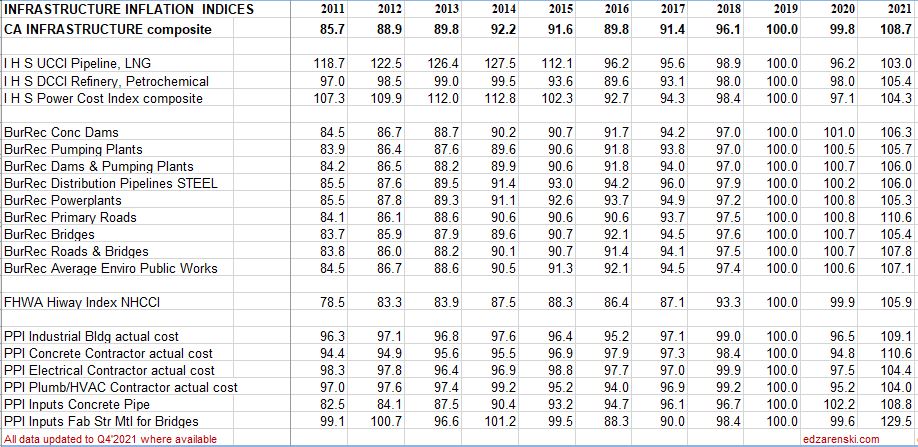
- 2-11-22 added INFRASTRUCTURE index table Q4 2021
This post is preserved for the multitude of LINKS back to sources of cost indices and for the explanation of the difference between Input indices and Output or Final Cost Indices. For all latest indices plots and table see the latest yearly Inflation post.
2-20-25 SEE Construction Inflation 2025
2-1-23 SEE Construction Inflation 2023
2-11-22 SEE Construction Inflation 2022
11-10-21 See 2021 Construction Inflation
See the article Construction Inflation 2020
Construction Cost Indices come in many types: Final cost by specific building type; Final cost composite of buildings but still all within one major building sector; Final cost but across several major building sectors (ex., residential and nonresidential buildings); Input prices to subcontractors; Producer prices and Select market basket indices.
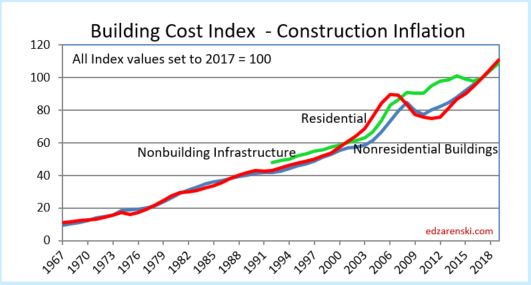
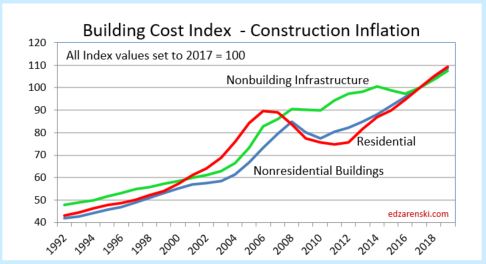
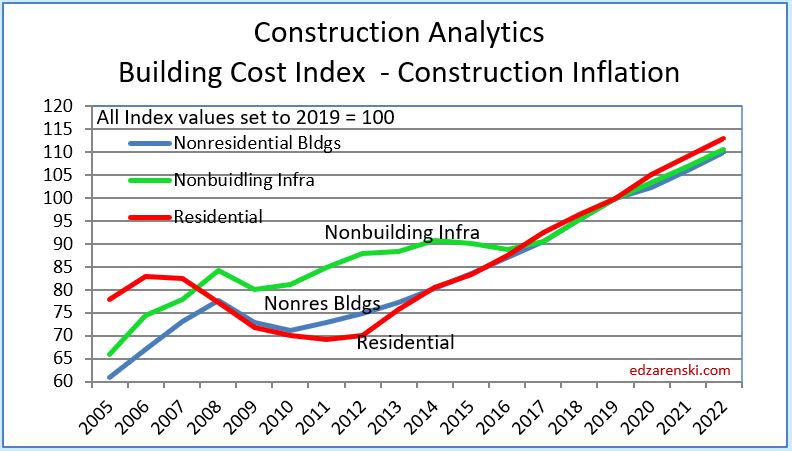
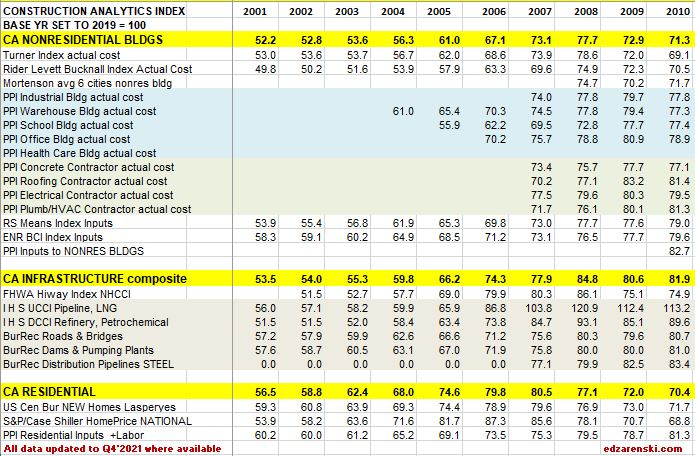
Residential, Nonresidential Buildings and Non-building Infrastructure Indices developed by Construction Analytics, (in highlighted BOLD CAPS in the tables below), are sector specific selling price (final cost) composite indices. These three indices represent whole building final cost and are plotted in Building Cost Index – Construction Inflation, see below, and also plotted in the attached Midyear report link. They represent average or weighted average of what is considered the most representative cost indicators in each major building sector. For Non-building Infrastructure, however, in most instances it is better to use a specific index to the type of work.
The following plots of Construction Analytics Building Cost Index are all the same data. Different time spans are presented for ease of use.
See the article Construction Inflation 2022
All actual index values have been recorded from the source and then converted to current year 2017 = 100. That puts all the indices on the same baseline and measures everything to a recent point in time, Midyear 2017.
All forward forecast values wherever not available are estimated and added by me.
Not all indices cover all years. For instance the PPI nonresidential buildings indices only go back to years 2004-2007, the years in which they were created. In most cases data is updated to include June 2019.
- June 2017 data had significant changes in both PPI data and I H S data.
- December 2017 data had dramatic changes in FHWA HiWay data.
SEE BELOW FOR TABLES
When construction is very actively growing, total construction costs typically increase more rapidly than the net cost of labor and materials. In active markets overhead and profit margins increase in response to increased demand. When construction activity is declining, construction cost increases slow or may even turn to negative, due to reductions in overhead and profit margins, even though labor and material costs may still be increasing.
Selling Price, by definition whole building actual final cost, tracks the final cost of construction, which includes, in addition to costs of labor and materials and sales/use taxes, general contractor and sub-contractor overhead and profit. Selling price indices should be used to adjust project costs over time.
quoted from that article,

R S Means Index and ENR Building Cost Index (BCI) are examples of input indices. They do not measure the output price of the final cost of buildings. They measure the input prices paid by subcontractors for a fixed market basket of labor and materials used in constructing the building. ENR does not differentiate residential from nonresidential, however the index includes a quantity of steel so leans much more towards nonresidential buildings. RS Means is specifically nonresidential buildings only. These indices do not represent final cost so won’t be as accurate as selling price indices. RSMeans Cost Index Page RS Means subscription service provides historical cost indices for about 200 US and 10 Canadian cities. RSMeans 1960-2018 CANADA Keep in mind, neither of these indices include markup for competitive conditions. FYI, the RS Means Building Construction Cost Manual is an excellent resource to compare cost of construction between any two of hundreds of cities using location indices.
Notice in this plot how index growth is much less for ENR and RSMeans than for all other selling price final cost indices.
8-10-19 note: this 2010-2020 plot has been revised to include 2018-2020 update.
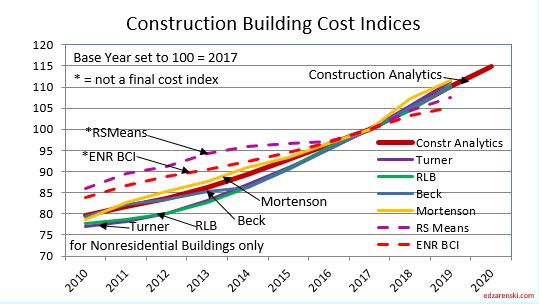
Turner Actual Cost Index nonresidential buildings only, final cost of building
Rider Levett Bucknall Actual Cost Index published in the Quarterly Cost Reports found in RLB Publications for nonresidential buildings only, represents final cost of building, selling price. Report includes cost index for 12 US cities and cost $/SF for various building types in those cities. Boston, Chicago, Denver, Honolulu, Las Vegas, Los Angeles, New York, Phoenix, Portland, San Francisco, Seattle, Washington,DC. Also includes cost index for Calgary and Toronto. RLB also publishes cost information for select cities/countries around the world, accessed through RLB Publications.
Mortenson Cost Index is the estimated cost of a representative nonresidential building priced in seven major cities and average. Chicago, Milwaukee, Seattle, Phoenix, Denver, Portland and Minneapolis/St. Paul.
Beck Biannual Cost Report in 2017 and earlier cost reports developed indices for six major U.S. cities and Mexico, plus average. In the most recent Summer 2021 report, while Beck provides valuable information on cost ranges for 30 different types of projects, the former inflation index is absent. Beck has not published city index values since 2017. Read the report for the trend in building costs. See discussion for Atlanta, Austin, Charlotte, Dallas/Fort Worth, Denver, Tampa and Mexico
Bureau of Labor Statistics Producer Price Index only specific PPI building indices reflect final cost of building. PPI cost of materials is price at producer level. The PPIs that constitute Table 9 measure changes in net selling prices for materials and supplies typically sold to the construction sector. Specific Building PPI Indices are Final Demand or Selling Price indices.
PPI Materials and Supply Inputs to Construction Industries
PPI Nonresidential Building Construction Sector — Contractors
PPI Nonresidential Building Types
PPI Materials Inputs and Final Cost Graphic Plots and Tables in this blog updated 2-10-19
PPI BONS Other Nonresidential Structures includes water and sewer lines and structures; oil and gas pipelines; power and communication lines and structures; highway, street, and bridge construction; and airport runway, dam, dock, tunnel, and flood control construction.
RS MEANS Key material cost updates quarterly
National Highway Construction Cost Index (NHCCI) final cost index, specific to highway and road work only.
The Bureau of Reclamation Construction Cost Trends comprehensive indexes for about 30 different types of infrastructure work including dams, pipelines, transmission lines, tunnels, roads and bridges. 1984 to present.
IHS Power Plant Cost Indices specific infrastructure only, final cost indices
- IHS UCCI tracks construction of onshore, offshore, pipeline and LNG projects
- IHS DCCI tracks construction of refining and petrochemical construction projects
- IHS PCCI tracks construction of coal, gas, wind and nuclear power generation plants
S&P/Case-Shiller National Home Price Index history final cost as-sold index but includes sale of both new and existing homes, so is an indicator of price movement but should not be used solely to adjust cost of new residential construction
US Census Constant Quality (Laspeyres) Price Index SF Houses Under Construction final cost index, this index adjusts to hold the build component quality and size of a new home constant from year to year to give a more accurate comparison of real residential construction cost inflation
TBDconsultants San Francisco Bay Area total bid index (final cost).
Other Indices not included here:
CoreLogic Home Price Index HPI for single-family detached or attached homes monthly 1976-2019. This is a new home and existing home sales price index.
Consumer Price Index (CPI) issued by U.S. Gov. Bureau of Labor Statistics. Monthly data on changes in the prices paid by urban consumers for a representative basket of goods and services, including food, transportation, medical care, apparel, recreation, housing. This index in not related at all to construction and should not be used to adjust construction pricing.
Jones Lang LaSalle Construction Outlook Report National Construction Cost Index is the Engineering News Record Building Cost Index (ENRBCI), a previously discussed inputs index. The report provides some useful commentary.
Sierra West Construction Cost Index is identified as a selling price index with input from 16-20 U.S. cities, however it states, “The Sierra West CCCI plays a major role in planning future construction projects throughout California.” This index may be a composite of several sectors. The link provided points to the description of the index, but not the index itself. No online source of the index could be found, but it is published in Engineering News Record magazine in the quarterly cost report update.
Leland Saylor Cost Index Clear definition of this index could not be found, however detailed input appears to represent buildings and does reference subcontractor pricing. But it could not be determined if this is a selling price index. A review of website info indicates almost all the work is performed in California, so this index may be regional to that area. Updated Index Page
DGS California Construction Cost Index CCCI The California Department of General Services CCCI is developed directly from ENR BCI. The index is the average of the ENR BCI for Los Angeles and San Francisco, so serves neither region accurately. Based on a narrow market basket of goods and limited labor used in construction of nonresidential buildings, and based in part on national average pricing, it is an incomplete inputs index, not a final cost index.
Vermeulens Construction Cost Index can be found here. It is described as a bid price index, which is a selling price index, for Institutional/Commercial/Industrial projects. That would be a nonresidential buildings sector index. No data table is available, but a plot of the VCCI is available on the website. Some interpolation would be required to capture precise annual values from the plot. The site provides good information.
CALTRANS Highway Cost Index Trade bids for various components of work and materials, published by California Dept of Transportation including earthwork, paving and structural concrete. Includes Highway Index back to 1972, quarterly from 2012.
Colorado DOT Construction Cost Index 2002-2019 Trade bids for various components of work published by Colorado Dept of Transportation including earthwork, paving and structural concrete.
Washington State DOT Construction Cost Index CCI for individual components or materials of highway/bridge projects 1990-2016
Minnesota DOT Highway Construction Cost Index for individual components of highway/bridge projects 1987-2016
Iowa DOT Highway Cost Index for individual components of highway/bridge projects 1986-2019
New Hampshire DOT Highway Cost Index 2009-2019 materials price graphs and comparison to Federal Highway Index.
New York Building Congress New York City Construction Costs compared to other US and International cities
U S Army Civil Works Construction Cost Index CWCCIS individual indices for 20 public works type projects from 1980 to 2050. Also includes State indices from 2004-2019
Eurostat Statistics – Construction Cost Indices 2005-2017 for European Countries
Comparative International Cities Costs – This is a comparative cost index comparing the cost to build in 40 world-wide cities If this International Cities Costs is a parity index, which involves correcting for difference in currency, then you must know the parity city in each country, which in the US I think is Chicago.
OECD International Purchasing Power Parity Index
Turner And Townsend International Construction Markets 2016-2017
Turner And Townsend International Construction Markets 2018
Rider Levitt Bucknall Caribbean Report 2018
US Historical Construction Cost Indices 1800s to 1957
Click Here for Link to Construction Cost Inflation – Commentary
2-12-18 – Index update includes revisions to historic Infrastructure data
1-26-21 The tables below, from 2011 to 2020 and from 2015 thru 2023, updates 2020 data and provides 2021-2023 forecast.
NOTE, these tables are based on 2019=100. Nonresidential inflation, after hitting 5% in both 2018 and 2019, and after holding above 4% for the six years 2014-2019, is forecast to increase only 2.5% in 2020, but then 3.8% in 2021 and hold near that level the next few years. Forecast residential inflation for the next three years is level at 3.8%. It was only 3.6% for 2019 but averaged 5.5%/yr since 2013 and returned to 5.1% in 2020.
11-10-21 Follow the link at the bottom to 2021 Inflation
The Tables below 2001 to 2010 and 2011-2020 are updated to Q4 2021 with any revisions to past years posted on source websites.
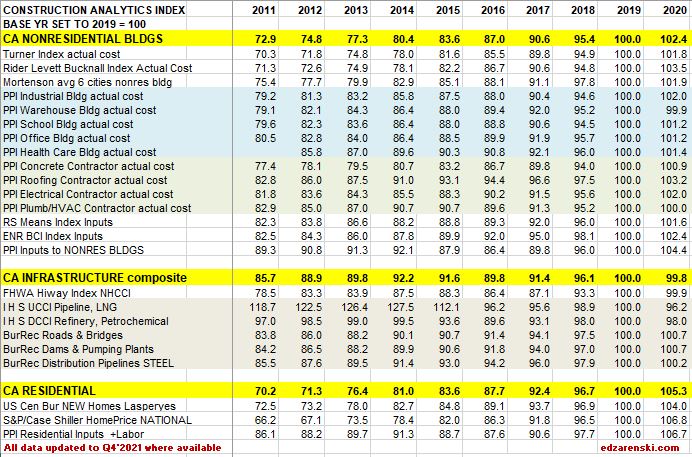
The Table below 2015 to 2023 is updated to Q4 2021

How to use an index: Indexes are used to adjust costs over time for the affects of inflation. To move cost from some point in time to some other point in time, divide Index for year you want to move to by Index for year you want to move cost from. Example : What is cost inflation for a building with a midpoint in 2022, for a similar nonresidential building whose midpoint of construction was 2016? Divide Index for 2022 by index for 2016 = 110.4/87.0 = 1.27. Cost of building with midpoint in 2016 x 1.27 = cost of same building with midpoint in 2022. Costs should be moved from/to midpoint of construction. Indices posted here are at middle of year and can be interpolated between to get any other point in time.
All forward forecast values, whenever not available, are estimated by Construction Analytics.
2-13-23 Construction Inflation 2023
Public Construction Spending 2016-2017
10-21-16
updated 2-16-17 edited to include 2016 year-end total$ public vs private
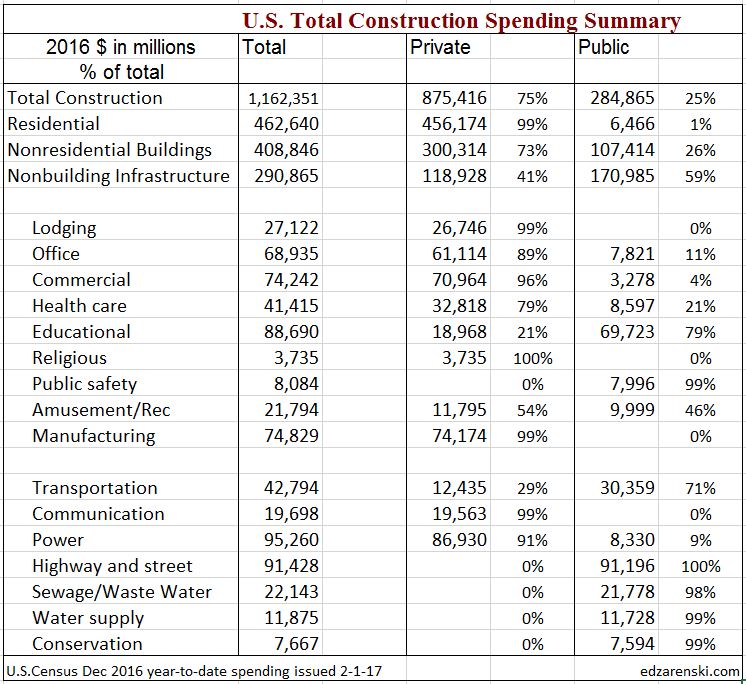
The two largest components of Public Construction Spending, by far, are Highway/Bridge/Street and Educational Buildings. These two markets have more impact on the magnitude of public spending than any other markets. All of Highway ($90bil) is public spending. About 80% ($70bil out of $88bil) of Educational buildings is public spending. Together they add up to 55% of all public construction spending.
The next three largest public markets in order are: 70% of Transportation ($30/$42bil); all of Sewage/Wastewater ($22bil) and all of Water Supply ($12bil). These three markets account for only about 22% of public spending. Eight remaining markets, none larger than 3.5% of the total public sector, combined make up ~20% of total public spending. Five of those eight, Office, Health care, Public Safety, Amusement and Power, each account for $8 to $10bil and each is 3% to 3.5% of Public work.
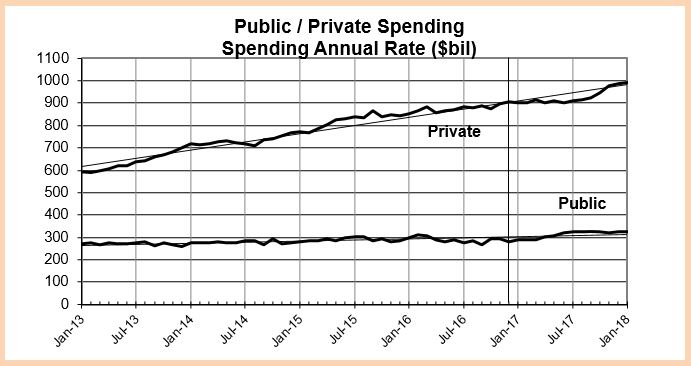
Public Construction Spending average for the first six months of 2016 was the highest since 2010 and is up 10% from the Q4’13-Q1’14 low point.
Public spending finished 2016 down 0.8% from 2015, but that is down from a near six-year high, so spending is still strong. It is still -9% below its 2009 peak.
The biggest mover to total public spending this year is educational spending. Public educational spending in 2016 is up 4.7%. Because it represents 25% of all public spending, it has a net impact of moving total public spending up +1.2%, greater impact than any other market.
Public commercial spending is up 24% but has only a 1% market share of public work so moves public spending by only +0.24%. Power is down -20% but at a share of only 3% moves public spending by only -0.6%. Public components of office, public safety, sewage/waste disposal and water supply are all down by a combined -7%. At a combined market share of 18% that nets a -1.26% reduction in total public spending.
Public spending peaked in 2009 when Educational buildings spending was at its highest. Highway spending has been at or near its peak for the last 16 months but that, with current educational spending, which is still more than 20% below its peak, has not been enough to carry public spending to new highs.
Expected spending predicted from new construction starts gives a much better picture for 2017.
Highway/Bridge/Street starts in 2015 finished just shy of a 6-year high (in 2013) but 2016 was down 13% from 2015. On average 2015+2016 starts are still 5% higher than 2014. Highway projects are long duration, so very good starts from the end of 2014 and the beginning of 2015 will still contribute strong spending well into 2017. Highway spending is expected to finish up slightly over 2016.
Educational new starts in 2016 finished the year up 11%, posting a 4th consecutive annual increase and educational spending for 2017 should finish up 10%.
Transportation spending in 2017 should increase 6%.
Overall, total public construction spending in 2017 is predicted to grow by 8% to 9%, the first substantial growth since 2007, reaching new highs in the 2nd half. Educational spending will take the lead in 2017 public work. Historically, public spending increases by less than 10% per year.
Starts Point to Robust 2017 Spending
10-20-16
Starts Point to Robust 2017 Spending
Construction Starts for September were released 10-18-16 from Dodge Data and Analytics. Here’s some of the major points that can be developed from the data:
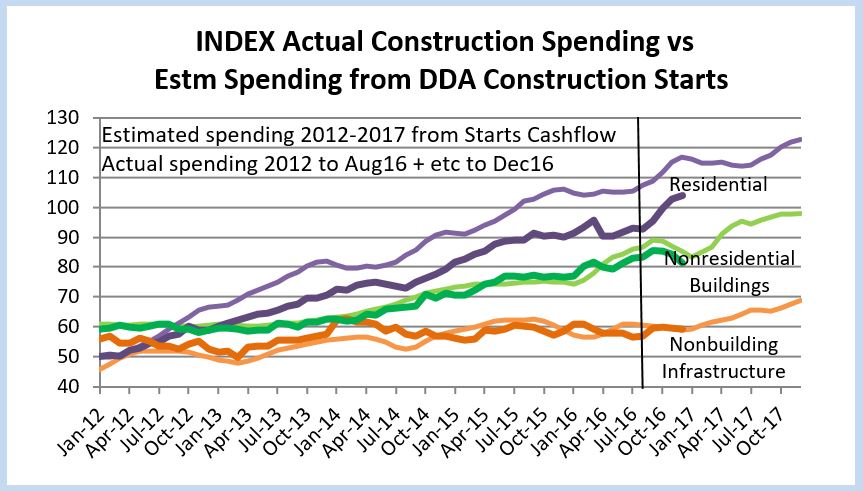
The six Nonresidential Buildings markets, Office (+30% YTD), Lodging (+50%), Educational (+10%), Healthcare (+20%), Commercial Retail (+15%) and Amusement/Recreation (+15%) make up 80% of all nonresidential buildings spending and account for combined growth of 16.5% in YTD new starts. Office and Lodging in 2016 will reach the 5th consecutive annual increase. Educational Markets, Commercial Retail and Amusement/Recreation will each record the 4th consecutive annual increase in total value of new starts. Spending combined for these six markets peaked in 2008 and dropped 37% to a bottom in 2012. For the last 3 years spending growth has ranged between 9%/yr and 12%/yr. For 2017, expect spending growth of 8%.
Manufacturing makes up 18% of nonresidential building market share. New starts 2016 YTD are down 54% from 2015. However, in 2014 and 2015 this market posted the fastest growth of any market in a decade and posted the two highest years on record for this market. It is currently settling back to a normal growth range. In 2014 starts increased 90%. In 2015 spending increased 33% to the highest ever recorded for manufacturing buildings. Spending will be down 2% to 3% in 2016 and down another 13% more in 2017, but 2017 will still be the 3rd highest year of spending on record.
Non-building Infrastructure starts will be down nearly 10% in 2016 but were up 25% in 2015. Power and Highway/Bridge/Street make up 2/3rds of non-building infrastructure spending. In 2015, Power starts increased 150% to an all-time high and Highway/Bridge/Street finished just shy of a 6-year high. It is not unexpected that starts in these markets will be down for 2016. The volume of monthly spending from projects started in 2014 and 2015 in this sector will contribute to spending for several years to come. Spending in 2017 will be the highest ever in this sector, up 7% from 2016.
Residential starts are having the best year since 2005-2006. Residential starts bottomed in 2009 and are now in the 7th consecutive year of growth. Although new starts will increase only about 7%-8% for 2016, that follows 4 years of growth averaging more than 20%/year. Spending peaked in 2005-2006 and dropped 60% to a low in 2009-2010. Spending has bounced 90% off the bottom in large part due to 17%/year average growth in 2013-2014-2015. Both starts and spending slowed in 2016 but still expect 7% to 8% spending growth in both 2016 and 2017.
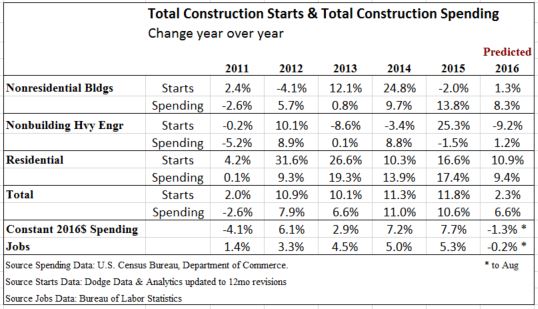
Starts are recorded in full in the month a project starts but the total project budget gets spent over a long duration, so the effects on spending are spread over the next 2 to 3 years. Total starts are Up 10%/yr to 12%/yr for the last 4 years. The current forecast for 2016 is growth of only 3.5%, but that now leads us to a very important factor that must be considered when using starts data to predict future spending.
There is a major factor that keeps new starts in the current year from appearing as good as they should. Dodge Data continually revises starts. In every monthly release, the previous month is revised AND the last year’s year-to-date is revised. Dodge does incorporate other (usually minor) revisions at a later date, but the “12 month” revision to the previous year-to-date values captures a large part of all revisions.
So this September report includes revisions to the total 2015 YTD values through September 2015. None of the 2016 values yet include that equivalent “12 month” revision and won’t until next year. But the current year YTD not-yet-revised values are being compared to the previous year YTD revised values which has the affect of making current year growth appear lower than it should.
In the last 10 years the YTD revisions have never been down. Usually, most of the revisions occur to nonresidential buildings, about 5% to 6% per year, with only a 2% to 3% revision each to infrastructure and residential.
For total nonresidential buildings, so far year-to-date 2015 values through September have been revised UP by 9%. So while the 2016 year-to-date nonresidential buildings value this month is noted as down 2% compared to last year, much of the reason it is down is because 2015 values have had revisions applied that increase the 2015 base by 9%. We won’t get those equivalent “12 month” revisions applied to 2016 values until next year. When all the revisions are in, new starts for nonresidential buildings (typically revised up by 5% to 6%) in 2016 are on track to equal or exceed 2015 and perhaps record the third consecutive year of over $220 billion. We are within easy striking distance of the all-time high for nonresidential buildings starts reached in 2007!
For residential starts, if 2016 values get revised up next year by only 2%-3%, then 2016 will have grown by nearly 10% over 2015. Unless we experience a severe downward trend in new residential starts, which is NOT predicted, 2016 will post an all-time high for new residential starts.
(Year-to-date by market and month/month values by market are not published.)
 Construction Analytics