Home » Posts tagged 'spending' (Page 11)

Tag Archives: spending

Construction Spending – Reports of It’s Death May Be Greatly Exaggerated

Is activity climbing or declining?  Will costs go up or down? Will we have a winter slowdown? Where are the markets headed? I read an article this morning that stated “momentum is losing steam.” Is it?

I’ve been gathering Construction economic reports for comparison and I see some predictions for 2016 that frankly are only about what I’m predicting for 2015. To be fair, there are reliable predictions that indicate growth similar to what I predict. When data was available for two thirds or better of 2015 total activity there were still predictions for how specific markets would finish the year that varied by as much as 20% to 30%. In one instance the year-to-date actual through September has already exceeded the year end estimate from one firm. Surprising, once that much actual year-to-date information is in hand that there could be that much variation.

And how will markets perform in 2016?  Here’s a few examples from a variety of sources; educational, healthcare, lodging and manufacturing all have more than one estimate for 2016 growth in the range of 0% to 4%, values that would not keep spending growth up with inflation, meaning volume would actually decline. My estimates for those markets are all 10% or higher. Variations of 10% to 15% in growth are common in the data.

So, here’s a few comments on predictions and on what to expect.

Unless something Earth-shattering happens, there is a select set of monthly data that statistically predicts the yearly outcome for total spending and market spending, within +/-1.5% for a smaller data set and within +/-1% for a slightly larger data set, but you have to wait longer to get that larger data set. It failed once in 14 years, by 1/2 of 1 percent. The same analysis can be performed individually for markets and sectors.  The potential variance increases for some markets to about +/-3%.

The Dodge Momentum Index and the AIA Inquiries index are leading indicators to potential future work.  They foretell activity in the Architectural Billings Index (ABI), which is a leading indicator to new construction starts. New starts provide the future cash flows for spending.

Spending in any given month is the sum of how much can be put-in-place generated by the cash flow from each of the project starts that got booked in the previous year or two, or three for long duration projects.  For the next month the unknown amount is only about 3% or 5% that will be generated by new starts in the most recent 30 days.  The remainder is already booked. Two months out the prediction includes 6% to 10% uncertainty, and so on.

Expect a winter slowdown. It’s not because of the weather. There may be additional repercussions if we experience severe weather, but the slowdown is predetermined because very large starts that got booked from a year to two years ago are reaching completion and dropping out of the monthly spending. Starts can be erratic.  This causes periodic fluctuations in monthly spending.  It’s normal.

Also what may not be apparent is what happens due to the difference in seasonally adjusted (SA) and not seasonally adjusted (NSA) values. Readers most often track the changes in SA values, but spending is generated from cash flow and cash flow is generated from the NSA values. Differences can be huge.  As an example, August starts with an SA of $300bil produce 50% more actual NSA dollar volume to cash flow than February starts with an SA of $300bil. This may cause erratic spending patterns.

Residential spending will slow several percent to a low point in February before resuming upward momentum to finish the year stronger than 2015. Periods of low start volumes need to work their way thru the system and this produces growth patterns with periodic dips.

Nonresidential buildings will slow only moderately in the next few months before we see 15% growth through the middle of the year, only to see another slowdown late next year, leading into a considerably slower 2017. Office new construction starts in 2015 are up 50% from 3 years ago, educational up 25% over same period. Manufacturing starts are down 70% in 2015 and that is still at the second highest ever recorded. Total spending is still strong in 2016 at 10% growth. Major contributions appear from institutional work in educational and healthcare. Office and manufacturing still provide very strong support to growth.

Infrastructure projects spending will decline for the next six months due to the ending of massive projects that started 24 to 42 months ago. There will be large advances in spending midyear before we experience another slowdown later in 2016. I’m currently predicting spending will grow less than 2% in 2016, held down by a 10% drop in Power the second largest component of infrastructure work.

Mixed within the three sectors above are Private and Public spending. Residential is about 98% private and makes up about 50% of all private work. Along with manufacturing and large portions of power, commercial/retail, office and healthcare makes up nearly 90% of all private work.  Private growth is the sum of the parts, predicted at 10%+ for 2016. Public work is all or a large portion of highway/street, educational, transportation and sewage/waste. Along with small contributions from water and a portion of power, these markets comprise 80% of all public work. Again, the sum of parts shows growth at 8% in 2016.

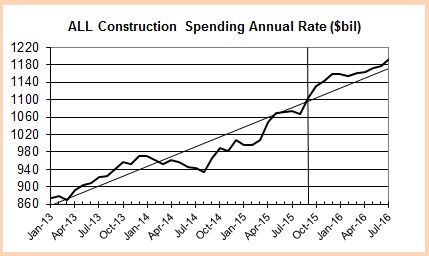
From the middle of Q1’16 to the end of Q3 we will register an annual growth rate of 20%, but due to the dips at the beginning and the end of the year total 2016 construction spending growth will come in at 11%. Construction spending momentum is not losing steam. We are seeing the affect of a few years of erratic growth patterns and a shift from commercial to institutional work.

Spend ALL 2014-2016 PLOT 12-1-15


Construction Spending Nonres Bldgs on a Roll > What it Means for Inflation

This is clearly going to measure up as the breakout year for spending on nonresidential buildings.  Growth year-to-date (YTD) is up 18.3%.  We will finish the year with total growth up 17%.  The last time we saw growth like this was 2007.  In fact, 2007 is the only time % growth (and $ volume growth) was ever larger than this year.

Since last December I have been predicting a range from 14% to 20% growth in 2015 nonresidential buildings spending. It looks like we will finish the year right in the middle of that range.

By far the largest $ contribution comes from the growth in manufacturing buildings, up 50% and up $23bil YTD.  Next closest is office buildings, up 22% and up $8.3bil YTD.  Lodging, Commercial-Retail, Educational and Amusement-Recreation are each up approximately $4bil YTD, quite impressive for Lodging and Amusement-Rec since they both total only $17bil YTD.

Nonresidential buildings spending will maintain greater than 10% growth in 2016 something achieved only 5 times in 25 years. Next year, educational and healthcare buildings will both contribute strongly to the total annual growth.  Manufacturing, Office and Lodging will all settle back but still maintain 10% or greater growth.  Commercial-retail, which had 3 years of substantial growth from 2012 to 2014 adding nearly 50% spending growth during that time, will grow only 2-3% next year.

With last year, this year and next, nonresidential buildings spending will reach growth of 40% in three years, a growth rate exceeded only once in history, during the last construction boom from  2006 to 2008. Along with that boom in spending came the highest construction inflation ever recorded, an average inflation over 8% per year for 4 years.  I expect we are headed there again.

Spend Compare NONRES BLDGS 12-9-15


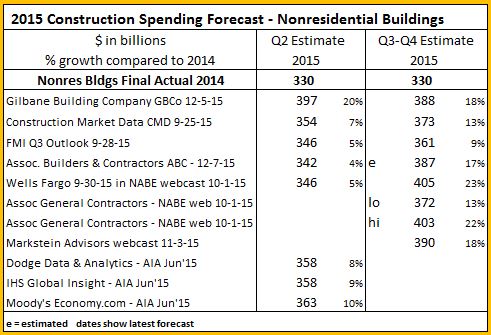
revised / updated table 12-9-15 to include ABC & BMarkstein forecasts.

Predictions – 2015 Spending for Nonresidential Construction Markets

Compiled in one neat table, here are 2015 predictions from eleven construction data firms for spending growth in nonresidential markets. Several firms provided mid-year estimates and recent estimates. Some provided only mid-year and some just recent estimates. Midyear estimates are separated so changes can be seen to current estimates.

Actual spending put-in-place for September year-to-date (YTD) became available November 2nd and new construction starts for October became available November 23rd.

There is a wide range of variance in predictions with the closest spreads at 9% and the widest spreads in lodging and manufacturing markets. It will be interesting to look back at this chart when the final numbers for 2015 become available in February 2016 to see how we did.

  • One recent estimate published in Engineering News Record (ENR) magazine 11-16-15 lists 7% growth for manufacturing buildings. Each of the first nine months in 2015, the year over year growth has ranged between 40% and 60%, so the huge growth expected has been apparent for some time. Even if the last three months drop 15% below the current average we will still finish the year up 40%.
  • For growth in educational buildings to fall to only 3%, the last three months would need to drop 15% below the current six month average, a change we will not very likely see.
  • The spread on lodging is 18%, from the low estimate of 15% to high of 33%.  YTD lodging through nine months is up 31% over last year. To finish at less than 25% growth in 2015, spending for the next three months would need to drop 20% from current levels.

We get a chance to tweak these numbers a little tighter when October spending gets released on December 1st.

Spend Compare MARKETS 11-23-15


Construction Spending – What You Need to Know About YTD Mo/Mo Yr/Yr

Common comparisons published in news reports for construction spending are, from best to worst:

  • Current year-to-date vs same period previous year. YTD
  • Current month vs previous month. Mo/Mo or MOM
  • Current month vs same month last year. Yr/Yr or YOY
  • Number of months to current value since last time that value achieved.

In some cases a comparison uses Not Seasonally Adjusted (NSA) dollars and in other cases Seasonally Adjusted Annual Rate (SAAR) dollars. NSA dollars is the actual amount spent within the month.  SAAR dollars represents the annual rate that monthly amount would generate based on the normal proportion typical spent within that month.  Typical spending is always much higher in summer months than winter to produce the same SAAR.

Year-to-date is the best comparison.  It increases in strength as more months are added to the YTD.  It is a value that gives a strong indication of growth over the previous year. Comparisons must be made using Not Seasonally Adjusted (NSA) dollars. Although it does lack adjustment for inflation, only one year of inflation is involved. Not adjusting for inflation is explained as the difference between current dollars and constant dollars.

Current month to month (MOM) comparisons are not generally affected by inflation but may not give a clear indication of movement due to monthly fluctuations. Comparisons absolutely must be made using Seasonally Adjusted Annual Rate (SAAR) dollars.  It is a gross error to make month to month comparisons using NSA dollars, since there is a normal spending curve that shows the percent of total annual spending can vary considerably from month to month, sometimes by as much as 10%. This variation is accounted for in the SAAR.

When comparing to the same month last year (YOY), the question arises, “Is any big change in YOY caused by the current month performance or by the performance in the same month last year?” Again, YOY is missing adjustment for one year of inflation. Comparison can be NSA or SAAR dollars.

Number of months/years since current value was last achieved is almost always presented as a current dollar comparison.  When dealing with cost, because of the long duration often involved it would be much better if it were a constant dollar comparison to account for construction inflation. However, construction inflation may not be readily available and this type of comparison is rarely if ever published using constant dollar comparisons. Comparison should use either entire year total dollars or should use SAAR dollars. 

Inflation Range 2000-2018 plot 2-21-17

Current dollars = dollars are reported in the value of the year reported 2008=2008$, 2015 = 2015$.  99% of news reports use current dollars and therefore do not account for the influence of inflation.

Constant dollars = all dollars adjusted to represent dollars in the year of comparison. Adjusts for inflation so 2008$ in this case are converted to equivalent 2015$.

It’s not to hard to understand why we need to use constant dollars when you think of it in terms of buying products like food or heating oil. Today heating oil costs $1.90/gallon. In 2008 heating oil cost $3.50/gallon.  So, with respect to oil, $350 in 2008 dollars is no different than $190 in 2015 dollars.

In addition to the Year-to-date growth values, here’s two more less common stats for looking at the same information.

Percent change from the last cycle high current$ (contant 2015$)

  • Residential  – Q1 2006  $390b vs $$680b  -43%  (-50%)
  • Nonresidential Buildings – Q1 2008  $392b vs $$439b  -11%  (-22%)
  • Nonbuilding Infrastructure  – Q1 2008  $298b vs $$286b  +4%  (-10%)

Percent change from the recent recession low current$ (contant 2015$)

  • Residential  – Q1 2011  $390b vs $$239b  +64%  (+48%)
  • Nonresidential Buildings – Q1 2011  $392b vs $$267b  +49%  (+35%)
  • Nonbuilding Infrastructure  – Q1 2008  $298b vs $$243b  +22%  (+13%)

Constant dollars makes a huge difference in the statistics. Just take a look at Nonresidential buildings.  Current dollars would indicate we are now only 11% below the previous high and we’ve had growth of 49% from the recession low.  Constant dollars adjusting for inflation shows we are still 22% below the previous cycle high and we’ve had growth of only 35% since the recession lows.

You can find a complete section providing constant dollar cost comparison in my quarterly report.  Access the report through the Featured Economic Report tab at the top of this blog

Erratic Pattern Ahead for 2016 Construction Spending. Why?

The good news is 2016 construction spending will be up across the board, although growth will vary between the three major sectors, residential, nonresidential buildings and nonresidential infrastructure. This post is about how we will get there.

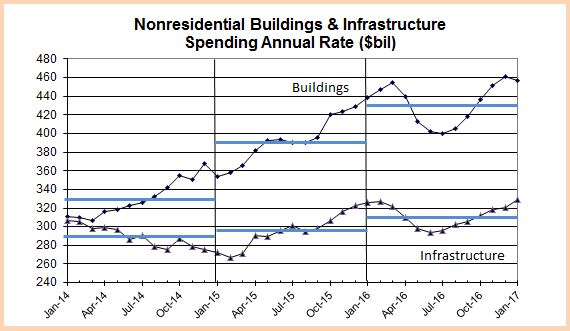
This plot shows a three year pattern of spending for nonresidential construction. The seasonally adjusted annual rate is plotted every month and the horizontal bars show the total average spending for each year.

Spend Nonres Bldgs and Infra Patterns

I often include a linear trend line in my plots because it’s good to be reminded of the long term direction and rate of growth rather than the monthly fluctuations.  I’ve removed the trend lines from this plot to make a point. A fairly typical growth year shows spending finishing the year at a higher rate than when we started. The total spending for the year (shown by the horizontal bars) is the sum of the unadjusted monthly values, which is the same as the average of the monthly adjusted rates of spending. The plot above shows spending for buildings totals of $330 billion in 2014, $390 billion in 2015 and $430 billion in 2016.

If spending always occurred evenly we would see a smooth constant slope plot line indicating the rate of growth, sometimes punctuated with minor monthly declines but over the long term up at a constant rate. The plot for buildings shows a pretty constant growth pattern from March 2014 to March 2016. We see a few slight monthly dips and a flat spot in mid-2015, but overall fairly constant growth.

That will all change in 2016.

The plot shows both buildings and infrastructure will experience multi-month declines in 2016.  By midyear both will dip so low that the year over year comparison will drop to near zero percent. Spending on buildings will drop more than 10% from the 1st quarter 2016 high to the midyear low. (edit 11-16. Most recent analysis is showing the nonresidential buildings peak and drop is moved out about 4 to 6 months.  The plot above does not reflect this most recent analysis.) Infrastructure will drop in a similar pattern but not as dramatically.  Both will resume growth and finish the year at or near the yearly high. Together these major sectors make up 60% of total construction spending with residential being the other 40%. The magnitude of these declines will be large enough to drag total construction spending down for the period, but it too will resume growth and finish the year well above where it started.

What causes that pattern?

Spending in any given month is the sum total contributed by all the projects that started and are currently underway. That includes spending from projects that started recently with foundations just coming out of the ground and also projects that started 18 to 24 months ago that are near completion and near ready for occupancy. Spending is affected by the pattern of starts recorded over the previous 24 months. Only if that pattern is even in growth will spending be even in growth.

Let’s make some assumptions for an example that should be easy to understand.

  • All projects take 20 months to build.
  • The construction budget gets spent at a constant rate of 5% per month.

Of course, reality never occurs as simple as that, but it makes for an easy to understand example. With these simple assumptions we know this about spending;

  • Every month includes some spending from all starts over the previous 20 months.
  • New starts in any given month contribute only 1/20th or 5% to total spending that month.
  • Predicted spending 3 months out includes only 15% from new starts, 4 months out 20%, etc.

Now, back to reality.

Nonresidential buildings spending in 2016 includes projects that started all the way back to mid 2014. From April 2014 to April 2015, concentrated mostly in mid to late 2014, there were several instances where monthly starts exceeded the previous month by 50%-60%, then settled back. Those were great months and indicated a huge growth spurt in nonresidential building construction. We see that growth from early 2014 all the way up to a peak in early 2016. Nonresidential buildings spending experienced growth of 9% in 2014 and 19% in 2015, with 9% growth predicted for 2016.

We don’t typically see a seesaw pattern in spending from the starts when all the projects are ongoing at the same time, we see flatter and steeper rates of spending growth. The six biggest months from that period averaged more than 30% higher than the current rate of new starts growth. So we’ve had a pause in the rate of increase for new starts. We see the big affect on the spending pattern when a very large volume of spending from starts 18 or 24 months ago reaches completion and drops out of the current month spending. That is what will happen in 2016.

New 2016 nonresidential buildings starts is not the cause of a 10% dip in spending in 2016. It is the completion of a very large volume of starts from 2014 that will no longer be contributing a large share to monthly spending.  That will work itself out by year end. But for those who do not look at the patterns that contribute to current spending it will create quite a stir.  Three to five months of consistent declines in spending will look like the end of recovery in nonresidential construction.  It is not the end.

Spend ALL 2014-2016

Construction Spending 2015 and 2016

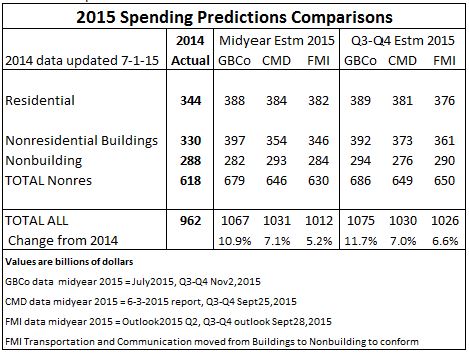
Here’s a peak at expected annual Construction Spending for 2015 and 2016.

Spend Early 2016 Estm Compare

My predictions (GBCo) include the latest actual construction spending data released Nov. 2nd for September spending. This updated projection also includes revised future spending based on Dodge Data & Analytics construction starts released at the DDA Outlook 2016 conference Oct. 30th. My prediction for total spending in 2015, now at $1.075 trillion, hasn’t changed much (up 0.7%) since August. However, for next year my projection has increased from $1.150 to now expecting total spending of $1.190 trillion in 2016. Both projections will be further refined in my winter economic report.

Why are my predicted values so much higher than other estimates?

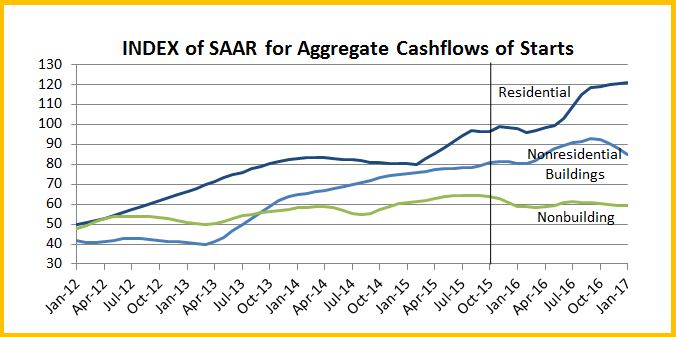
I put emphasis on using the cash flows from all previously recorded construction starts to predict future construction spending. I’ve talked about and documented in past reports the correlation between these two data sets. For 2015, with only three months left to go, 80% to 90% of all starts that will generate spending in the final three months are already in place.

Very little affect on total 2015 spending will be brought about by new construction starts in the 4th quarter. New starts could crash to a level less than one half of current trends and that would still not affect total spending enough to get below $1.050 trillion for the year. In order to have the final total spending come in less than $1.040 trillion, the rate of spending for each of the next three months would need to drop off to the level of a year ago. That is not what the cash flows are indicating. In fact, cash flows are indicating spending will increase in the final three months of 2015. The cash flow plot provides us with the direction and the rate of change, but not the actual value of spending.

Starts Cashflows Nov 15 rvsd


With the September actual spending values included in the data, the statistical average of predicted spending for 2015 is $1.073 trillion. My cash flow analysis by sector predicts 2015 will finish at $1.075 trillion. In 11 out of 14 years, the actual final value has been within 0.5% of the predicted.

The statistical analysis gives a predicted range for total 2015 annual spending between $1.066 trillion and $1.086 trillion. The actual spending total has not fallen outside the statistical range since 2001, as far back as I’ve been tracking the data. I’m confident that total spending for the year will fall within this predicted range.

Construction Spending Projected 2015 Totals

Here’s a comparison of projections for total construction spending in 2015.

Spending Predictions TOTALS Nov2-15

My numbers (GBCo) include the latest actual construction spending data released Nov. 2nd for September spending.  This updated projection also includes revised future spending based on Dodge Data & Analytics construction starts released at the DDA Outlook 2016 conference Oct. 30th.  My prediction for total spending in 2015, now at $1.075 trillion, hasn’t changed much (up 0.7%) since August.  However, for next year my projection has increased from $1.150 to now expecting total spending of $1.190 trillion in 2016.  The 2016 projection will be further refined in my year-end report.

With the September spending values in the data, the statistical average predicted spending for 2015 is $1.073 trillion. My cash flow analysis by sector predicts 2015 will finish at $1.075 trillion. In 11 out of 14 years, the actual final value has been within 0.5% of the predicted.

The statistical analysis gives a predicted range for total 2015 annual spending between $1.066 trillion and $1.086 trillion. The actual spending total has not fallen outside the statistical range since 2001, as far back as I’ve been tracking the data.

Here’s a summary of predictions for several of the major markets.  Again, my predictions from earlier in the year haven’t changed too much.

Spending Predictions MARKETS Nov2-15

In today’s data release from U.S. Census, spending for manufacturing buildings was lowered in both July and August, and September came in lower than I expected.  That is the primary mover in the lower prediction for nonresidential buildings. Spending for manufacturing buildings is at an all-time high. Through September, spending on new manufacturing buildings has already reached an all-time annual high.  Manufacturing buildings helped 2015 spending for nonresidential buildings reach 19% growth but this won’t continue and I expect 2016 growth of 10%.

Residential spending has been a nice surprise to the upside.  The current rate of growth for the last 12 months  is 17%/year and this rate of growth is expected to continue again in 2016.

Spending Predictions TOTALS GRAPH Nov2-15

Heard at Dodge Data Outlook 2016, Oct. 30, 2015

Dodge Data & Analytics Outlook 2016 event held in Washington DC, October 30, 2015.

A brief summary of comments heard and information from my notes.

Art Gensler – Founder Gensler

How do you control 5000 people?  Hire good people and get out of their way.

People value what they pay for and ignore what they get for free.

Beth Ann Bovino – U.S.Chief Economist, Global Economics & Research, Standard & Poor’s

Domestic economy is strong and strengthening.

Jobs are stronger – Quits rate is at a 7 year high.

Housing starts are up – Home prices are up.

Wages are struggling and we have a historical 38 year low labor participation rate.

Ted Hathaway – CEO Oldcastle BuildingEnvelope

We increased wages significantly to keep people from leaving.

The cost and disruption is huge if you lose a valuable member of a team.

Dan McQuade – President, Construction Services, AECOM

Three emerging trends

Global collaboration

Investing capital with clients and partners

Better collaboration with vendors & suppliers. Treat subs and vendors as partners.

Larry Kudlow – Economist and Senior Contributor CNBC

Our biggest problem – We do not have strong steady economic growth.

Corporate profits were high after recession but have declined last three quarters. Profits were likely responsible for the stock market rise.

Bob Murray – Vice President, Economic Affairs, Dodge Data & Analytics

The DMI is reflecting the institutional dip has ended and now beginning to grow, although slowly.

New construction starts 2013 = 11%, 2014 = 9%, 2015 = 13%p

Actual $ put-in-place 2013 = 7%, 2014 = 5%, 2015 = 10%

New starts that declined in 2015 Warehouses, Stores, Public Bldgs, Manufacturing

New Starts that increased in 2015 Residential, Hotels, Highway, Electric-Gas-Power

Expectations for 2016

Total new construction starts up 6%.

Residential up 16%, single family will grow faster than multifamily.

Commercial up 11%, led by warehouses and stores

Institutional up 9%, led by educational

Manufacturing down 1%, but from very high 2014 and 2015

Power down 43% from extreme high starts in 2015

Construction cycles may be indicating we have years of growth left in the current cycle.

Nonresidential Buildings Construction Spending 2015 – How Do Industry Predictions Compare?

Throughout the year a number of firms provide predictions of various construction data.  Some firms provide estimates for all segments of construction.  More firms provide estimates only for spending on nonresidential buildings.  This is a summary of various firms estimates published in the 2nd quarter and also for those who’ve updated their estimate recently.

The current available spending data through August allows an analysis of a select data set that gives a prediction of the year end result within +/- 1.5%. My current data predicts 2015 will finish with nonresidential spending at $393 billion, with a potential range between $387 billion and $400 billion. We will have even better data on November 2nd when the US Census publishes construction spending for the month of September. Once the September data is incorporated into the monthly totals, an analysis of a select data set provides a prediction of the year-end totals that has not varied more than +/- 1% from the end-of-year actual since 2002, as far back as the market data is available.

Comparison Nonres Bldgs

Construction Spending or Construction Starts – Media Headlines That Get it Confused

Here’s a headline published recently.

“Construction spending rose year-over-year during first 9 months of 2015”

What they really meant to say

“Construction STARTS rose year-over-year during first 9 months of 2015”

Why make a big deal out of this.  Well, here’s an example.  The brief states “nonbuilding work climbed 35%” during the first nine months of 2015 compared to same months 2014.  TRUE, if we look at new construction STARTS, but construction spending for non building work is down 2.5% during the first 8 months of 2015 vs 2014 (Sept spending won’t be available until November 2nd).

Construction starts help us understand where future spending is headed.  Construction spending is based on how much is occurring this month from all the projects that started in the previous 12 to 30 months.

Let’s use an example to understand new construction starts vs construction spending:

Assume:

All the nonresidential building projects that start in a given month have a schedule duration of 20 months.

The total starts in this month is $60 billion.

Over a duration of 20 months they will average a put-in-place construction spending of 60/20 = $3 billion a month. Spending follows a typical bell curve, starts out slow, gets real strong in the middle and finishes slow. The spending cash flow from these new starts will begin slowly at a rate of perhaps $1 to $2 billion/month, it will peak in about 10 to 12 months at perhaps $4-5 bil/mo, and then will taper to the finish again at about $1-2bil/mo. It will take 20 months to spend this $60 billion in new starts from this single month.

The point here is this:  Current spending is based on the last 2 to 3 years of starts.  New starts will generate the next 2 to 3 years of spending.  Don’t get the two confused.  Big increases in new starts is not telling us how much spending is going on right now, it’s telling us how much spending to expect in the future.  And to get the real picture of what to expect in the future we need to look at the cumulative cash flow that occurs in any given future month from all the previous starts that are still ongoing. Furthermore, the construction starts values that are published every month represent a sampling of new construction activity, approximately 50% to 60% of total construction activity.  While the total reported construction starts for a year might be $500 to $600 billion, the total spending in that year will be more like $1.0 to $1.1 trillion.