Home » Posts tagged 'Forecast' (Page 6)
Tag Archives: Forecast

Construction Spending 2021 updated 7-2-21
Construction Spending Actual through May 2021
Total Construction Spending is up 4.6% year-to-date (ytd) from the same five month period 2020. Residential is up 23.4%, Nonresidential Buildings is down -10.5% and Nonbuilding Infrastructure is down -5.8%.
This analysis includes spending revisions to 2019 (up $26bil, +1.9%) and 2020 (up up $37bil, +2,6%).
In the 1st 3 months of 2020, spending had reached an all-time high averaging a SAAR of $1,521 billion.
In the 1st 3 months of 2021, spending again hit a new all-time high averaging a SAAR of $1,544 billion. In May, spending is $1,545 billion.
Year-to-date through May, while residential is up 23%+, 15 of 16 nonresidential markets, 98% of total nonresidential market value, are down a total of -8.6%. For the remainder of the year, the rate of nonresidential decline will slow to -4%.
Construction starts are leading the way to recovery, but construction spending, which is dependent mostly on starts from previous years (2020 down -22%), will remain depressed for nonresidential construction well into 2022. Recovery in backlog begins to build in a few markets in 2021. However, new nonresidential starts could double from the current rate of growth and it still wouldn’t be enough to turn 2021 nonresidential spending positive.
Aside from residential, recovery to the levels of revenue (spending) recorded in Q1 2020 won’t show up before 2024.
The following table shows ytd through May $ and forecast for 2021/2022. Almost every nonresidential market is down ytd and down compared to the average in Q1 2020 before Pandemic Recession.

The impact of reduced starts in 2020 is showing up in the 2021 year-to-date results. Total Nonres Bldgs starts were down 22% in 2020. Nonbldg Infrastructure starts were down 13%. Some of these markets will be affected by a downward trend in spending for two to three years.
2020 starts for select markets:
- Amusement -38%
- Commercial/Retail -14%
- Office -20%
- Lodging -50%
- Manufacturing -57%
- Power -38%
The greatest downward impact on spending will be felt in mid-2021. Over the next 9 months, every sector will post more down months than up months, although the declines will be most noticeable in nonresidential buildings.

For the next few months the residential year-to-date comparison will be skewed. It is going to increase due to the steep fall-off in spending back in April and May 2020. Then, months of strong growth, a total +38% in 7 months in residential from May 2020 onward, with no equivalent growth increase this year, will cause ytd comparisons to decrease. So, even though residential spending is not forecast to increase any more in 2021, residential spending will peak at +25% year-to-date in the May-June data (due to the steep decline in spending in 2020) before falling back to end at +16% ytd for year end.
While most markets recover to positive new starts growth in 2021, spending growth lags, showing the downward trend in 2021 as a result of lost starts in 2020.
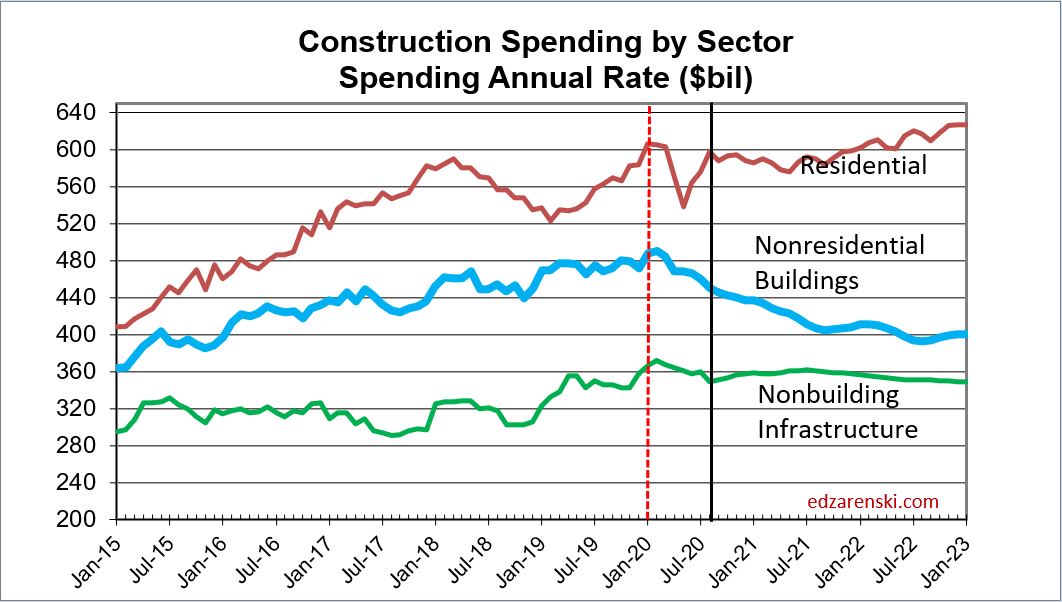
This next plot changes the scale of the spending plot so the nonresidential buildings data can be visualized much easier. This is the exact same data as in the Construction Spending by Sector plot above. The scale change helps immensely to visualize the decline in nonresidential buildings spending. By midyear 2022, the annual rate of spending will be 20% lower than the pre-pandemic peak. It could take two to three years after that to recovery to the pre-pandemic level of spending.
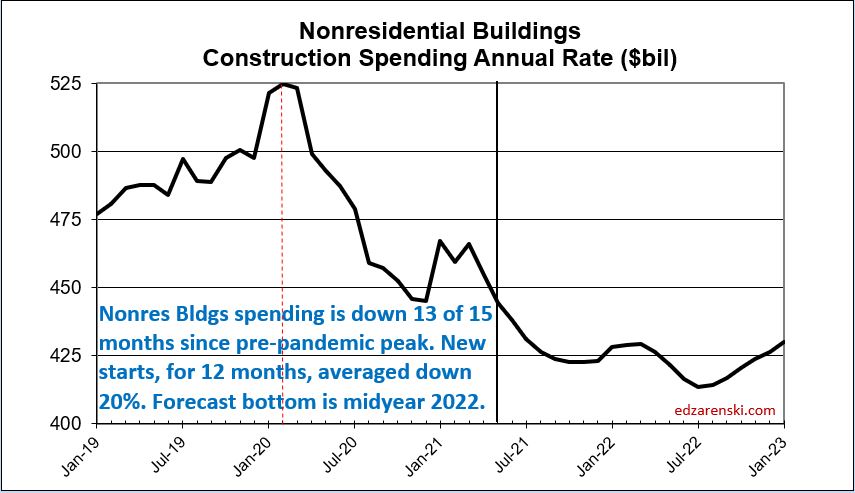
A typical batch of new construction starts within a year gets spent over a cash flow schedule similar to 20/50/30, that is, 20% of all starts in the year gets spent in the year started, 50% in the next year and 30% in years following. Total nonresidential buildings starts in 2020 were down -22% ($100bil in spending) and nonbuilding was down -13% ($50bil). Under normal conditions, we know how much of that $150 bil would have occurred in 2020, 2021 and 2022. That’s a loss of spending this year, and that loss remains a steeply downward slope as long as starts remain depressed. Nonresidential buildings starts, down now for 12 months, posted some hint of recovery in April.
If new infrastructure bill starts don’t begin until the 2nd half of the year, only 25% to 30% (of the 1st year 20/50/30 that is based on 12mo) gets spent in the 1st year. Therefore, even if $100 billion in new infrastructure starts begin in the 2nd half 2021, only 30% x 20% or only about 6% would get spent in 2021. That’s $6 billion, or less than 1% of annual construction spending. So, there will be very little if any impact on 2021 construction spending as a result.
In constant $, spending adjusted for inflation, even though residential constant $ volume is up 13% from Q1 2020, current total $ volume of work is 5% lower than the peak average in Q1 2020. This will fall another 5% by year end 2021.
JOBS DATA updated 7-2-21
Construction Jobs for June (May16 thru June12) are down slightly (-7,000) from May. May was revised down slightly (-6k) and April (-4k) revised down slightly. Jobs are now down 3 consecutive months. Comparing jobs year-over-year is strongly skewed by the rapid declines then rapid growth in 2020. Year-to-date thru June construction is up only 10,000 jobs. Jobs are down 238K (-3.1%) from Feb 2020 peak. But also, hours worked dropped -1.3%, equivalent to another 100,000 jobs. Expect this downward trend to accelerate into year end.
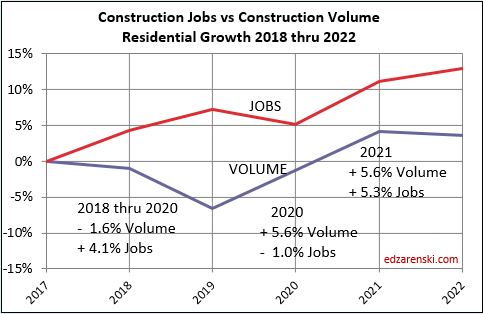
Construction spending minus inflation (Volume) supports jobs. All of the increase in construction spending this year is INFLATION. There is no meaningful increase in construction volume to support jobs growth.
Construction spending is on track to increase 3.8% in 2021 over 2020. But after taking out average 6% inflation, spending minus inflation in 2021 will be DOWN 2%. Residential spending increases $103 billion (+16%), but after 8% inflation residential volume increases only $47 billion. All nonresidential spending decreases $47 billion but after adjusting for 4% inflation real nonresidential volume is down $77 billion. Total construction volume (spending minus inflation) is expected to decline 5% from May to Dec. Construction Jobs are expected to follow suit.
Although residential jobs are currently increasing, nonresidential jobs will continue to fall, dropping another 4% over the next 12 months. This time next year construction could be down another 200,000 jobs.

2021 Construction Economic Forecast – Summary
Initial Construction Outlook 2021, 2-5-21, based on data from:
- Actual Jobs data includes BLS Jobs to Jan 16th, issued 2-5-21
- Forecast includes US Census Dec 2020 year-to-date spending as of 2-1-21
- Forecast includes Dodge Outlook 2021 and Dec construction starts 1-19-21
SUMMARY – CONCLUSIONS
Construction Spending drives the headlines. Construction Volume drives jobs demand. Volume is spending minus inflation. Current outlook shows the most recent peak volume was 2017-2018. Total Volume is forecast to decline every year out to 2023, but Residential is rising, Nonresidential is falling.
When spending increases less than the rate of inflation, the real work volume is declining. Nonresidential buildings spending for 2020 is down -2%, but with 3% to 5% inflation, volume is down 5% to 7%. The extent of volume declines would impact the jobs situation.
STARTS – BACKLOG – SPENDING
By far the greatest impact of the pandemic on construction is the massive reduction in new nonresidential construction starts in 2020 that will reduce spending and jobs in that sector for at least the next two years. Residential continues to increase.
- 2020 new starts declined -8%. Res +7%, Nonres Bldgs -24%, Nonbuilding -14%.
- New starts for residential reached an all-time high in 2020. Expect up +5% in 2021.
Nonresidential construction starts in backlog at the beginning of the year provide for 75% to 80% of all spending in 2021. New starts in 2020 were down 24% for buildings and 14% for non-buildings, so backlog is down. It would be difficult to show any scenario that has these sectors up in 2021.
Construction has yet to experience the greatest downward pressure from the pandemic. After hitting a post-pandemic spending high in December, spending and jobs losses won’t hit bottom until 2022. Nonresidential declines outweigh Residential gains.
- Spending forecast for 2021 is up +1.4%, but nonresidential buildings is down -11%.
- Almost all gains in spending are due to large 12%/yr gain in residential.
The largest declines in 2021 spending are Lodging -37%, Amusement/Recreation -26%, Manufacturing -19% and Power -15%.
PROJECT COST ESCALATION – INFLATION
- Inflation for nonresidential buildings near 4% the next few years. Residential 5% to 6%.
VOLUME – JOBS
Construction Jobs annual average for 2020 is down 220,000 jobs. The current spending forecast is indicating that December 2020 was the highpoint for jobs. Residential jobs will be up in 2021, but Nonresidential Buildings jobs are down steep. Net jobs will be down 15 of next 18 months. Forecast 2021 net annual average jobs losses of -200,000. Nonresidential Buildings 2021 jobs losses will outweigh residential gains.
Selected slides from Feb 2021 Construction Outlook Presentation
EdZ Econ Feb 2021 SAMPLE SLIDES PDF
Read More 2021 Construction Economic Forecast
2021 Construction Economic Forecast
Initial Construction Outlook 2021, 2-5-21, based on data from:
- Actual Jobs data includes BLS Jobs to Jan 16th, issued 2-5-21
- Forecast includes US Census Dec 2020 year-to-date total spending as of 2-1-21
- Forecast includes Dodge Outlook 2021 and Dec construction starts 1-19-21
This analysis utilizes Dodge Data & Analytics construction starts data to generate spending cash flow to then determine how spending may affect future construction activity.
When spending increases less than the rate of inflation, real work volume is declining. In 2020, nonresidential buildings spending is down -2%, but with 3% inflation, volume declined 5%. The extent of volume declines negatively impacts the jobs situation. A 5% decline in Nonresidential Buildings volume impacts $22 billion worth of work and more than 100,000 jobs. In 2021, spending is forecast down 11%, volume down 14%.
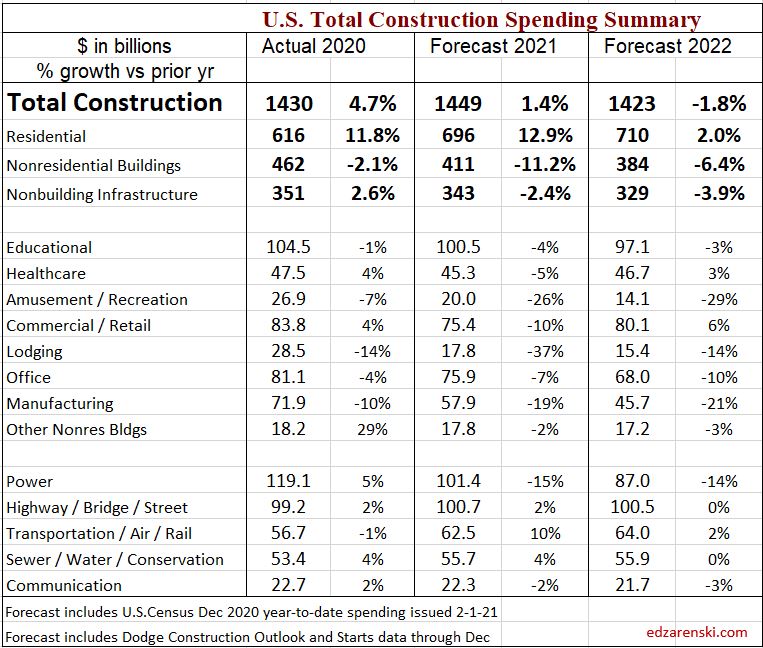
2021 Residential spending will climb about 13%, up $80 billion to $695 billion. Nonresidential Buildings spending is forecast to drop -11% to $410 billion, a decline of $50 billion. Non-building spending drops -2% to $343 billion, a decline of only $8 billion.
By far the greatest impact of the pandemic on construction is the massive reduction in new nonresidential construction starts in 2020 that will reduce construction spending and jobs for at least the next two years. Although nonresidential buildings spending is down only -2% for 2020, the 15% to 25% drop in 2020 new construction starts will mostly be noticed in lower 2021 spending.
New Construction Starts
Total construction starts for 2020 ended down -8%, but Nonresidential Buildings starts finished down -24% and Non-building Infrastructure starts are down -14%.
Residential starts finished the year up +7% from 2019.
Most nonresidential buildings markets and residential new starts are forecast to increase 5% in 2021. Nonbuilding starts will increase 10% in 2021.
In the Great Recession, beginning in Q4 2008, nonresidential buildings new construction starts fell 5%, then fell 31% in 2009 and 4% in 2010. Spending began to drop by Dec 2008, then dropped steadily for the next 24 months. Spending dropped 40% over that next two years. During that period, residential starts and spending fell 70%.
In 2020, nonresidential buildings starts fell 24%, but the six months from Apr-Sep, starts fell 33%. Starts are forecast to fall 4% in 2021. Nonres Bldgs spending began to decline in Aug, is now down 10% from Feb high and is forecast to drop steadily the next 20 months, for a total decline of 25%. This time around residential starts and spending are increasing.
Over the final 5 months of 2020, new Residential construction starts posted 4 of the 5 highest monthly totals since 2004-2006. Residential new starts finished 2020 at a 15-year high, with almost 50% of new activity for the year posting in the final 5 months, which will put a lot of that spending into 2021. Total 2020 residential starts are up 7%, but the average for the last 5 months is up 10% from the same period 2019. There is a large portion of 2021 spending from that last 5 months of starts, that will be up 10%.
Nonresidential Buildings new construction starts in 2020 averaged down 24%: Manufacturing -57%, Lodging -46%, Amusement/Recreation -45%, Education -12%, Healthcare -7%. Most of the spending from those lost starts would have taken place in 2021, now showing up as a major decline in spending and work volume.
Manufacturing starts in 2020 fell 57%. Manufacturing projects can have a moderately long average duration, because some projects are 4-5 years. So, projects that fell out of the business plan starting gate in 2020 caused a drop in starting backlog of -32% for 2021 and -33% for 2022. It should not be hard to see how that leads to a huge decline in construction spending the next two years. The same thing happened with Amusement/Recreation and Lodging, although lodging tends to have shorter duration, so affects mostly 2021.
Commercial/Retail starts in 2020 dropped 16%. But this group includes warehouses which finished the year up +1% and warehouses is 60% of the total market. All other Commercial/Retail ended 2020 down 35%.
Non-building Infrastructure new construction starts in 2020 averaged down -13%. Power -37%, Transportation -22%. Highway (along with residential) was the only market to gain new starts in 2020, +8%.
Power new starts fell 37% in 2020, but Power backlog has not increased since 2018. Even though Power new starts in 2021 are forecast to increase 13%, that’s not enough to push spending to positive.
Transportation starts declined -22% in 2020. But Transportation backlog increased 50% over the last three years. There is a large volume of Transportation projects currently in backlog, and although backlog does drop slightly for 2021, spending is supported by the large volume of starting backlog and a forecast for increased new starts in 2021.
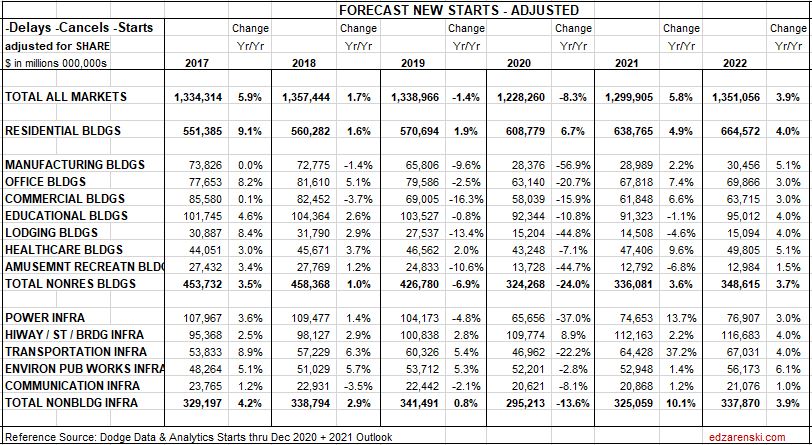
The following NEW STARTS table shows, for each market, the current forecast for new construction starts. With exception of residential, spending in all other markets, due to longer schedules, is most affected by a decline in new starts, not in the year of the start, but in years following. As we begin 2021, some effects of reduced starts have not even begun to show up in the data. A 24% decline in new nonresidential starts in 2020 results in a huge decline in spending and jobs in 2021-2022.
Almost every nonresidential construction market has a weaker spending outlook in 2021 than in 2020, because approximately 50% of spending in 2021 is generated from 2020 starts, and 2020 nonresidential starts are down 24%, with several markets down 40%. Starts lead to spending, but that spending is spread out over time. An average spending curve for nonresidential buildings is 20:50:30 over three years. Only about 20% of new starts gets spent in the year they started. 50% gets spent in the next year. The effect of new starts does not show up immediately. If new nonresidential buildings starts in 2020 are down 24%, the affect that has in 2020 is to reduce spending by -24% x 20% = – 4.8%. The affect it has in 2021 is -24% x 50% = -12%. In 2022-2023 the affect is -24% x 30% = -7.2%.

Starting Backlog
Starting backlog is the estimate to complete (in this analysis taken at Jan 1) for all projects currently under contract. The last time starting backlog decreased was 2011.
Backlog leading into 2020 was at all-time high, up 30% in the last 4 years. Prior to the pandemic, 2020 starting backlog was forecast UP +5.5%. Due to delays and cancelations, that has been reduced to +1.8%, still an all-time high. Starting Backlog, from 2011-2019, increased at an avg. rate of 7%/year.
If new construction starts are greater than construction spending in the year, then for the following year starting backlog increases. It’s when new starts don’t replenish the amount of spending in the year that backlog declines. And that is the case this year.
Total starting backlog is down -10% for 2021 and -5% for 2022. 2021 Starting Backlog is back to the level in 2018. In 2022, backlog drops to the level of 2017.
Nonresidential Buildings new starts declined by -24% in 2020 resulting in starting backlog drops -19% for 2021 and drops -9% for 2022.
For Non-building Infrastructure, a drop of -14% in 2020 starts results in a drop of 9% in 2021 starting backlog and -5% for 2022.
Residential starting backlog for 2021 is up +12%. New starts are up 6%.
2021 backlog declines in every nonresidential market, except Highway.
80% of all nonresidential spending in any given year is from backlog and could be supported by projects that started last year or 3 to 4 years ago. Residential spending is far more dependent on new starts than backlog. Only about 30% of residential spending comes from backlog and 70% from new starts.
Projects in starting backlog could have started last month or last year or several years ago. Many projects in backlog extend out several years in the schedule to support future spending. Current backlog could still contribute some spending for the next 6 years until all the projects in backlog are completed.
Reductions in starts and starting backlog lead to lower spending. Residential construction is going counter to the trend and will post positive results for new starts, backlog and spending for the next two years. Nonresidential buildings will experience the greatest reductions in new starts, backlog and spending through 2022.
Spending Forecast 2021
2021 Residential spending will climb about 13%, up $80 billion to $695 billion. Nonresidential Buildings spending is forecast to drop -11% to $410 billion, a decline of $50 billion. Non-building spending drops -2% to $343 billion, a decline of only $8 billion.
Most all the change in this forecast from previous is an increase to residential spending. Both recent starts and spending increased substantially since previous forecasts. When looking at Total Construction Spending for 2021, residential growth obscures the huge declines in nonresidential.
The monthly rate of spending for residential increased 33% in the 7 months from May to December. The last time we had growth like that was 1983. The last time we had rapid growth in residential work, 2013-2014 and 2004-2005, it took 2 years to increase 33%. Residential spending in Dec 2020 is 21% higher than Dec 2019.
Nonresidential Buildings spending drops -2% to -3% each quarter in 2021. Nonresidential Buildings spending as of Dec. 2020 is down 10% From Feb. 2020 and 8% from Q4 2019. By 3rd quarter 2021, nonresidential buildings spending is forecast down another 12% lower than Dec. 2020, or 20% below the Feb. 2020 peak. This tracks closely with the 24% decline in new construction starts in 2020.

Nonresidential Buildings construction will take several years to return to pre-pandemic levels. Although nonresidential buildings spending is down only -2% for 2020, the 15%-25% drop in 2020 construction starts will mostly be noticed in lower 2021 spending. Project starts that were canceled, dropping out of new backlog between April and September 2020, would have had midpoints, or peak spending, March to October 2021. Nonbuilding project midpoints could be even later. The impact of reduced new starts in 2020 is reduced spending and jobs in 2021 and 2022.
Almost every market has a weaker spending outlook in 2021 than in 2020, because of lower starts in 2020. Starts lead to spending, but on a curve. A good average for nonresidential buildings is 20:50:30 over three years. 20% of the total of all starts in 2020 gets spent in 2020 (yr1) and that represents also about 20% of all spending. 50% of the total value of 2020 starts gets spent in the following year, 2021. So, 50% of spending in 2021 is generated from 2020 starts. If starts are down 20% and 50% of spending comes from those starts, spending will be down 20% x 50% of the work.
For 2020, the biggest declines are Lodging (-14%), Manufacturing (-10%) and Amuse/Recreation (-7%). Commercial/Retail finishes up +4.2%, but this is entirely due to Warehouse, 60% of the total Commercial/Retail market. Office and Educational are down -4% and -1%. Nonresidential buildings takes the brunt of declines in both 2020 and 2021.
In 2021, every nonresidential building market is down from 2020, some markets down -10% to -20%. Educational, Healthcare and Office are all down -3% to -6%. Non-building infrastructure Power market is down -15%, but Transportation spending is up +10% due to strength in backlog from several multi-billion$ starts over the past few years.
Manufacturing projects have a moderately long duration. So, projects that fell out of the business plan caused a drop in starting backlog of -32% for 2021 and -33% for 2021. It should not be hard to see how that leads to a huge decline in construction spending the next two years. The same thing happened with Amusement/Recreation and Lodging, although lodging tends to have shorter duration, so affects mostly 2021.
A recent AGC survey of construction firms asked, how long do you think it will be before you recover back to pre-COVID-19 (levels of work)? The survey offered “longer than 6 months” as an answer choice. Less than 6 months was the right answer for residential, but my current forecast for full recovery of nonresidential buildings work is longer than 6 years.
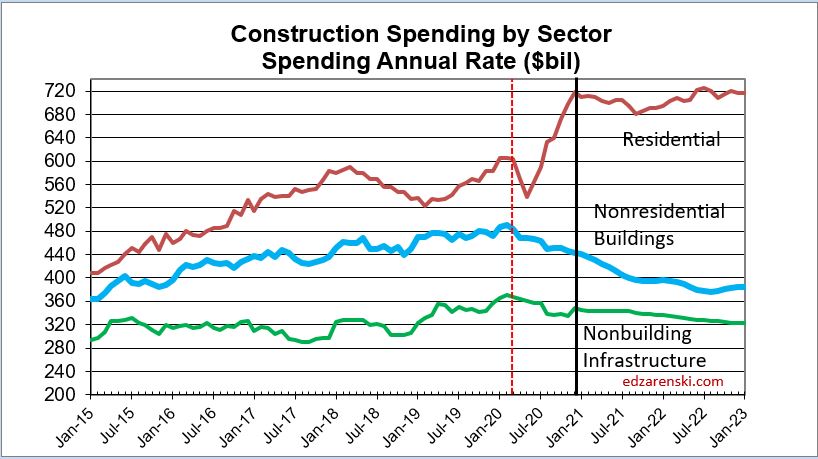
Construction Spending drives the headlines. Construction Volume drives jobs demand. Volume is spending minus inflation. Inflation $ do not support jobs. Current outlook shows (recent) peak volume was 2017-2018. Volume is forecast to decline every year out to 2023.
Before we can look at the effect on jobs, we need to adjust spending for inflation. The plot above “Spending by Sector” is current dollars. Below that plot is adjusted for inflation and is presented in constant $. Constant $ show volume. Notice future residential remains in a narrow range after adjusting for inflation. No sector shows improvement in volume through Jan. 2023.
When we see spending increasing at less than the rate of inflation, the real work volume is declining. For example, with construction inflation at 3% annually, a nonresidential buildings spending decline of -2.1% in 2020 would reflect a work volume decline of 5.1%. The extent of volume declines would impact the jobs situation.
While 2021 Residential spending will climb about 13%, Nonresidential building spending is forecast to drop -11% and Non-building spending drops -2%.
But with 4% inflation, after inflation Residential Volume is up only 9%, Nonresidential Building is down 15% and Non-building is down 6%.
By far the greatest decline in volume is in the nonresidential buildings sector. The greatest losses in 2020 are Lodging, Manufacturing, Amusement/Recreation and Commercial/Retail (without warehouse). In 2021, every major nonresidential building market drops in volume, with staggering 30% declines in Lodging and Amusement/Recreation. Commercial/Retail and Manufacturing will drop -13% to -15%.
Here’s the same graphic as above, but in Constant $, so it’s inflation adjusted. That provides the change in volume of work.
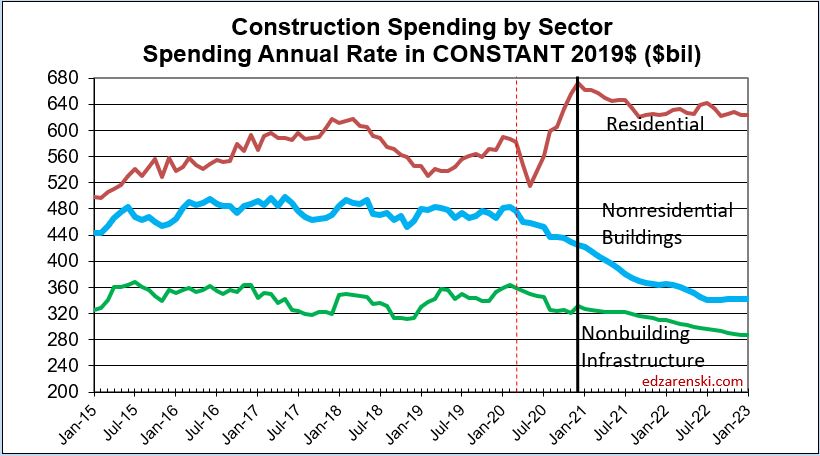
Volume of Work
Residential construction volume dropped 12% from the January 2020 peak to the May bottom, but has since recovered 22% and now stands at a post Great Recession high, 10% above one year ago. Although residential spending remains near this high level for the next year, volume after inflation begins to drop by midyear.
Nonresidential volume has been slowly declining and is now down 10% from one year ago. By 3rd quarter 2021, nonresidential buildings volume is forecast down another 15% lower than December, or 25% below the Feb 2020 peak. This tracks right in line with the 24% decline in new construction starts in 2020. Most of the spending from those lost starts would have taken place in 2021, now showing up as a major decline in spending and work volume.

While construction spending in 2021 is forecast up 1.3%, after inflation construction volume is expected to decline 2.5%. Residential construction spending is forecast up 13%, volume up almost 9%, but 2021 nonresidential buildings spending is forecast down -11% leading to a decline in volume after inflation of -14%. Nonbuilding Infrastructure spending in 2021 declines -2.5%, volume drops -6%.
Nonresidential buildings volume declines of 14% project to a loss of over 400,000 jobs next year and non-building infrastructure is projected to drop 60,000 jobs, but Residential could experience growth next year of 250,000 jobs. That could net annual average jobs losses to -200,000. Job losses continue into 2022 with net volume declines of 4%.
Jobs are supported by growth in construction volume, spending minus inflation. We will not see construction volume return to Feb 2020 level at any time in the next three years. This time next year, volume will be 5% lower than today, 10% below the Feb 2020 level.
Download the complete 2021 Initial Forecast here
Along with this forecast document, See these related articles
2021 Construction Economic Forecast – Summary
Measuring Forecasting Methodology & Accuracy
Public/Private Construction Spending Forecast 2020-2021
Measuring Forecasting Methodology & Accuracy
7-1-21 Updated to 2020 actual spending revisions issued 7-1-21. Also updated initial 2021 forecasts to include May 2021 year-to-date actual spending.
1-30-21 How can we tell if the adjusted starts forecasting method produces reliable results?
This plot of predicted spending from the starts cash flow model compared to actual spending is a check on this analytical modeling method. It shows a comparison of the cash flows predicted from all construction starts vs actual spending. If the forecast plot is accurate, then actual spending should move in the same direction, at the same slope. While we sometimes see lag in the plots movement, over time, the cash flow model of new starts does a good job of predicting where spending is headed.
The Dec 2020 chart below incorporates changes to residential (only residential has been modified) from earlier 2020 forecasts: no delayed projects canceled; all delayed spending restarted by August; new construction starts beginning in August, for the final 5 months of 2020, fastest growth in 15 years. This shows the latest starts data as adding to the recovery forecast between May and December and moving the future forecast residential spending line up on the index.

Settings in the pandemic forecast model resulted in the residential divergence. First, projects delayed were predicted to take six to eight months to come fully back up to production. But residential project spending was fully back to prior levels by August, within 3 months from the May bottom. About 60% of the return to prior spending was supported by growth in residential renovations. The rapid growth in spending is represented by the steep recovery in the spending curve between May and August. Second, a small portion of jobs delayed were predicted to be canceled permanently. Based on the spending data, this likely did not occur at all, or the impact was very small. Finally, Dodge at that time was forecasting that residential new starts in 2020 would finish the year down slightly. With December starts data now in, residential starts for 2020 finished up 4%. In fact, over the final 5 months of 2020, new residential construction starts posted 4 of the 5 highest monthly totals since 2004-2006. Residential new starts finished 2020 at a 15-year high, with almost 50% of new activity for the year posting in the final 5 months, which will put a lot of that spending into 2021.
Here’s the most recent forecast with 2020 revisions updated 7-1-21

The nonresidential buildings plots (and the residential plot prior to 2020) are remarkably close, providing an indication the method of analysis employed, cash flow of all construction starts to get spending forecast, is reasonably accurate. Below is the nonresidential plot to a larger scale.

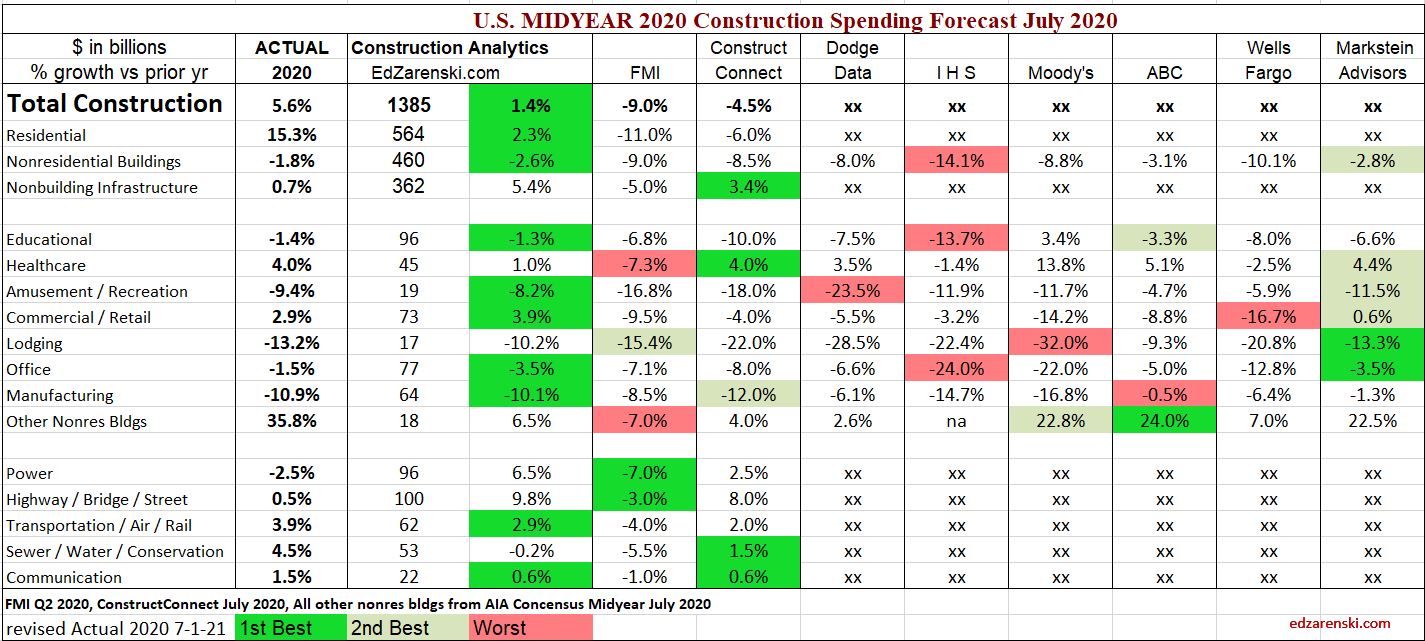
The table below shows the 2020 forecasts published at midyear by numerous analysts, the first opportunity to incorporate impacts from the pandemic recession. This table compares Construction Analytics Midyear July 2020 forecast to eight firms that reported nonresidential forecasts in the AIA Midyear July Outlook. Two of those firms, FMI and ConstructConnect, also published full forecast reports at midyear. The Actual totals for 2020 based on data through December (2020 data revised 7-1-21), are shown in the first column. Forecasts, all compared to Actual 2020, are marked best, 2nd best, worst. Where there’s limited comparison (Total, Residential and Non-building), only the closest is marked.
Construction Analytics midyear 2020 forecast garnered more best estimates than any other firm when comparing Midyear estimates to actual totals for the year. No one got residential correct, some reasons cited above, but Construction Analytics was the closest. I think it’s fair to say, Construction Analytics Midyear 2020 forecast was closest to 2020 Total Actual overall. Though, I do remember some other times with red in my column. Markstein Advisors had a close 2nd best nonres bldgs midyear 2020 forecast.
7-1-21 Actual YTD 2020 updated to include 2020 revisions for final comparison.
This next table shows the current forecast for full year 2021 forecast published as of January 2021. Of the eight nonresidential markets in the AIA Outlook report, the spread between hi and low forecast is 14%-17% for 4 markets, but 24%-25% for 3 markets and a spread of 45% for lodging. Spreads that wide are indicating some forecasts are all over the place. This will get compared next January when we know the Actual amounts for 2021. Watch closely nonresidential buildings.
Also, in July, along comes the Midyear Outlook, when usually forecasts improve a bit. That also will get compared next January.
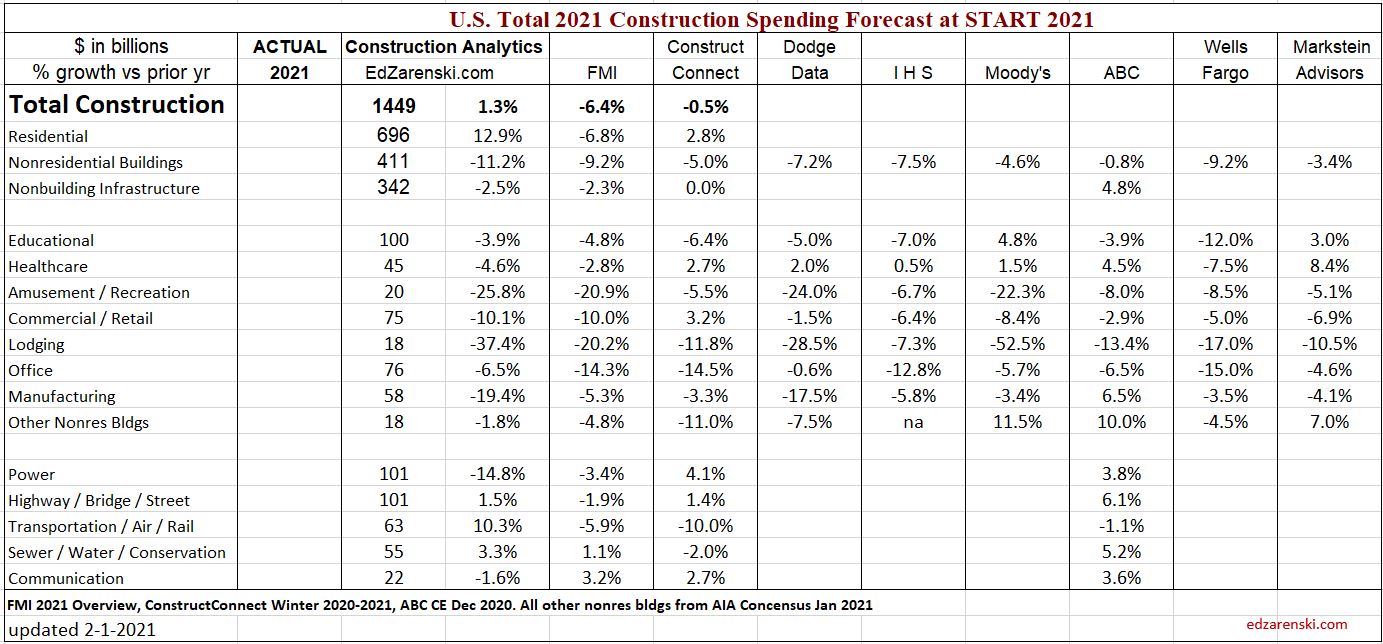
7-1-21 table below includes May ytd actual spending for latest comparison. Forecasts are all at start of 2021.

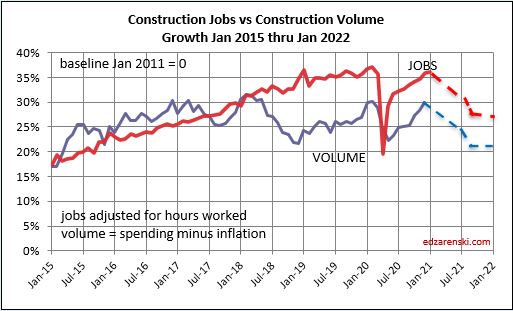
Construction Jobs in 2020 down 220,000
edited 3-5-21 to include 2020 revised jobs and 2021 revised outlook.
Construction closes 2020 down 157,000 jobs comparing Dec 2020 to Dec 2019. Average jobs lost over the year is down 220,000, down 2.9%. Also, average hours worked in 2020 is down. The equivalent jobs lost over the year (jobs x hours worked) is down 3.8% or a loss of 281,000 jobs equivalent.
While construction spending in 2021 is forecast up 1.3%, after inflation construction volume is expected to decline 2.5%. Residential construction spending is forecast up 13%, volume up almost 9%, but 2021 nonresidential buildings spending is forecast down -11% leading to a decline in volume after inflation of -14%. Nonbuilding Infrastructure spending in 2021 declines -2.5%, volume drops -6%.
Nonresidential buildings volume declines of 14% project to a loss of over 400,000 jobs next year and non-building infrastructure is projected to drop 60,000 jobs, but Residential could experience growth next year of 250,000 jobs. That could net annual average jobs losses to -200,000. Job losses continue into 2022 with net volume declines of 4%.
It is notable though, even with residential spending and volume increasing, due to large losses in nonresidential buildings, total construction volume declines every month for the next 9 months. Nonresidential buildings volume declines for the next 18 consecutive months.
There is an unusual occurrence in the data for 2021. Annual average jobs in 2021 may decline in total by only 100,000, but from Dec. 2020 to Dec. 2021, jobs decline may be nearer to 400,000. The annual average change is much less due to the massive decline in jobs in April 2020, which by itself caused the 2020 average to drop by almost 100,000. Most months in 2021 will show jobs about 3% to 4% or more below the same month in 2020, except for April, which will show 2021 jobs 10% higher than 2020.
Some who read this post will question how I forecast such a drop in nonresidential work, when some other analysts predict far less declines and even some who predict nonresidential work increases in 2021. It will be very difficult for anyone to support a forecast for increased spending in 2021 given a 22% drop in new construction starts in 2020 for nonresidential buildings work, most of which would have occurred in 2021.
https://www.bls.gov/web/empsit/ceseeb1a.htm

Public/Private Construction Spending Forecast 2020-2021
12-18-20
Public Starts and Backlog
Leading into 2020, the Public markets with the highest growth in new starts the previous two years were Transportation and Public Works. Transportation terminals and rail starts were up 15% over two years, 25% in the last three years. Backlog nearly doubled in three years because a large portion of those starts is very long duration projects. Public works starts were up 13%, 20% in three years, and backlog is up 40%. Infrastructure projects typically have the longest duration. Projects contribute spending sometimes up to 5 or 6 years.
Public work backlog leading into 2020 was up an average 8%/year for the last three years. Some of this is very long-term work that started construction in 2017 and it will still contribute spending for the next several years. 40% of all public spending in 2020 comes from projects that started prior to Jan 2019.
2020 losses in new construction starts impact the forecast for the next few years. Total new starts in 2020 for Public work dropped 9%. Transportation starts fell 20%, Educational starts fell 11% and Public works fell 6%. Amusement/Recreation starts fell 40%. Highway/Bridge starts increased 4%.
2021 Starting Backlog for all Public work is down 5%. Backlog for Transportation projects drops only 4%, and that leaves 2021 still 2nd only to the all-time high in 2020. Both Educational and Public Works backlogs drop 7%. Amusement/Recreation backlog falls 40%. Highway backlog increases 3%. Of all public work in backlog at the start of 2021, 43% comes from projects that started prior to Jan 2020.
Public Spending
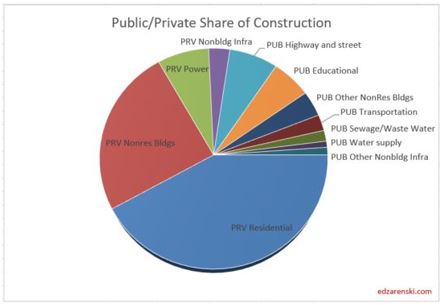
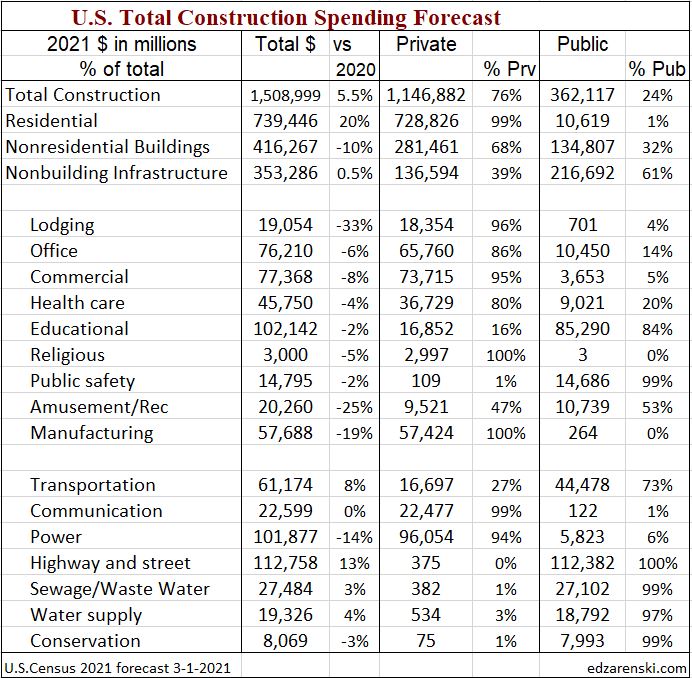
The two largest markets contributing to public spending are Highway/Bridge (30% of total public spending) and Educational (25%), together accounting for 55% of all public construction spending. At #3, Transportation is only 12% of public spending. Environmental Public Works combined makes up 15% of public spending, but that consists of three markets, Sewage/Wastewater, Water Supply and Conservation. Office, Healthcare, Public Safety and Amusement/Recreation account for about 3% to 4% each.
Highway is 100% public and Public Works 98%. Educational is 80% public, Transportation 70%, Amusement/Rec 50% and Healthcare 20%.
Total public spending for 2020 is projected to finished up 5% at $350 billion. Spending for every major public market is projected to finish up in 2020. By far, the largest Public spending increases measured in dollars for 2020 are Educational, Transportation and Public Safety.
Total public spending in 2021 is projected to finished up 5% at $370 billion. Transportation provides most of the gains in 2021 and Public Works adds some, but this forecast may come down without support from Highway or Educational.

Public Infrastructure and Public Institutional
A bit less than 60% of all Non-building Infrastructure spending, $198 billion in 2020, is publicly funded. That public subset of work has averaged growth of $5 billion/year from 2013 through 2019, with maximum growth of $16 billion in 2019. 2020 increased only $4 billion. In 2020, Non-Building Infrastructure spending makes up about 60% of Public spending.
About 30% of all Nonresidential Buildings spending, $141 billion in 2020, is publicly funded. It’s mostly Educational. That public subset of work has averaged growth of $6 billion/year from 2013 through 2019, with maximum growth of $10 billion in 2017. 2020 increased $14 billion. In 2020, Nonresidential Buildings spending makes up about 40% of Public spending.
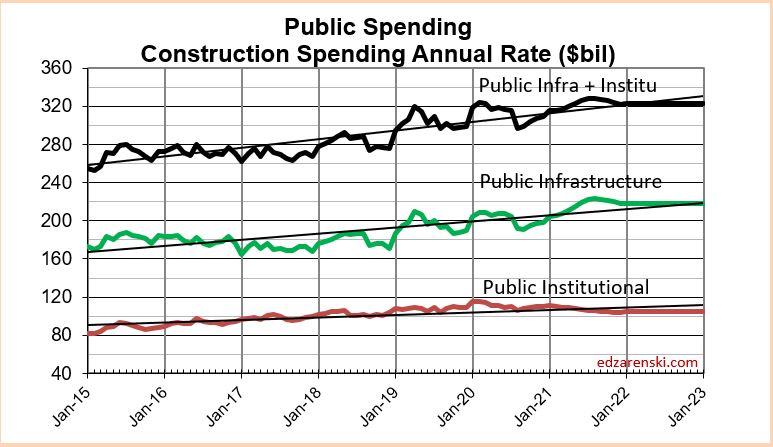
- Infrastructure = $349 billion, ~25% of all construction spending.
- Infrastructure is about 57% public, 43% private. In 2005 it was 70% public.
- Public Infrastructure = $198 billion. Private Infrastructure = $150 billion.
- Power and Communications are mostly privately funded infrastructure.
- Nonresidential Buildings is 30% public (mostly institutional), 70% private.
- Educational, Healthcare and Public Safety are Public Nonres Institutional Bldgs
- Public Commercial construction and Amusement/Rec. are not included.
- Public Institutional = $110 billion, mostly Education ($86b).
Public Infrastructure + Public Institutional = $308 billion, 22% of total spending.
Public Infrastructure + Institutional average growth is $12 billion/year. This subset has never exceeded $30 billion in growth in a single year. In 2019 spending increased $20 billion. With 10 months data posted, 2020 is forecast to increase $17 billion.
Although total all public spending may increase for 2021, the select group of Infrastructure + Institutional likely to be funded by an Infrastructure stimulus bill shows 2021 growth is uncertain and may remain flat.
See Also
Down the Infrastructure Rabbit Hole
Infrastructure – Ramping Up to Add $1 trillion
Where is Construction Outlook Headed?
The greatest impact to construction spending from fewer new starts in 2020 comes in 2021 or early 2022, when many of those projects would have been reaching peak spending, near the midpoint of the construction schedule. Nonresidential starts in 2020 are down 15%-25%. Residential starts are up 2%.
Construction Spending for October https://census.gov/construction/c30/pdf/release.pdf…
Up 1.3% from Sept. Sept rvsd up 0.4%. Aug rvsd up 1%
Year to date (ytd) spending is up 4.3% over Jan-Oct 2019. Oct SAAR is now only 2% below Feb highpoint.
However, residential spending ytd is up 9.6%, nonresidential building spending is down -1.2%. Both are expected to keep heading in the direction currently established.
Nonresidential Buildings construction will take several years to return to pre-pandemic levels. Although nonresidential buildings spending is down ytd only -1.2% (as of October data), the gapping hole left by the 15%-25% drop in 2020 construction starts will mostly be noticed in 2021 spending. Project starts that were canceled, dropping out of revenues between April and September 2020, would have had midpoints April to September 2021. Nonbuilding project midpoint could be even later. The impact of reduced new starts in 2020 is reduced spending and jobs in 2021 and 2022.
Construction Jobs are projected to fall in 2021. While 2021 Residential spending will climb about 10%, Nonresidential building spending is forecast to drop -10% and Non-building spending drops -4%.
After adjusting for inflation, Residential volume is up about 4% to 5%, Nonresidential buildings volume is down about -14% and Non-building volume will finish down -8%. Jobs should follow suit.
If jobs increase faster than volume, productivity is declining. Also that means inflation is increasing.
Spending is approximately 50% residential, 30% nonresidential buildings and 20% nonbuilding infrastructure.

Residential Construction Booming
RESIDENTIAL Construction Spending for October Up 2.9% from Sept
Sept spending rvsd up 1.5%, Aug rvsd up 3.5%
August highest new starts monthly total ever.
Year to date Oct. spending now up 9.6% over Jan-Oct 2019
Oct monthly SAAR now 2% higher than Feb highpoint.
Residential construction starts for Jul-Aug-Sep-Oct’20 posted the highest 4mo total ever. 2nd highest was Nov-Dec’19-Jan-Feb’20. In the last 12 months residential construction starts have posted 7 of the top 10 best months ever. Also, spending in Aug, Sep and Oct is the highest since the previous residential boom in 2005-2006. Spending is now already +2% higher than previous high in Feb and 2020 finishes up +10%. Spending climbs +10% higher in 2021.
Advanced Preconstruction Presentation – Construction Economics 11-4-20
Attached
EdZ Presentation Construction Economic Forecast 11-4-20 HW w notes
Here’s a few short notes
- 2020 spending will close the year UP.
- 2021 will get dragged down by declines in nonresidential buildings.
- Reduced new construction starts in 2020 impact 2021 far more than they impact 2020.
- Residential spending has returned to now only 2% less than the pre-pandemic peak in February.
- There will be hidden inflation not showing up in wages or material costs – lost productivity, acceleration.
There are other analysts reports that 2020 total construction spending will finish the year down -2%. Here’s why that will not happen.
Through August, year-to-date spending is up +4.2%. To finish the year down -2% (with only 4 months to go) would require each month of the final 4 months spending to come in at -14% year-over-year (yoy =compared to the same month last year). Not a single month this year has posted spending yoy lower than last year. Also, -14% yoy for 3 months would idle more than 1 million jobs for 4 months. That would make the final 4 months of 2020 the absolute worst period ever recorded.
September data is in (not included in the presentation) and makes it even more unlikely. Year-to-date September spending is up 4.1%, so Oct, Nov, and Dec would have to each post yoy spending of -20% for the year to end down 2%.
Similarly, the data show by an even wider margin, nonresidential buildings spending will not end 2020 down -10%.
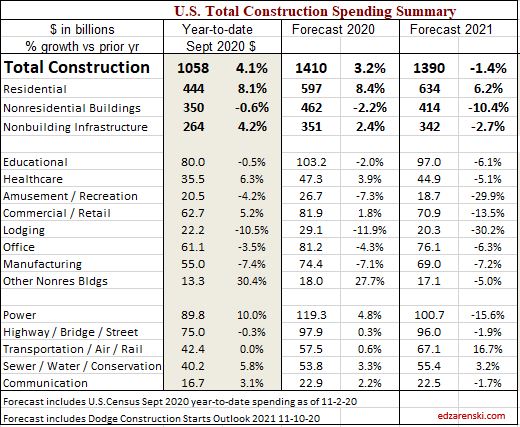
This table updates the slide included in this presentation. It includes September spending year-to-date and Dodge Outlook 2021 for new forecast on construction starts in both 2020 and 2021.

Construction Forecast Update 10-16-20
UPDATES to Construction Outlook 10-16-20 based on
- Forecast includes US Census Aug 2020 year-to-date spending 10-1-20
- Forecast includes Dodge September construction starts 10-15-20
- Actual Jobs data includes BLS Jobs to Sept (12th) issued 10-2-20
This update accompanies pandemic-13-midyear-construction-outlook
Total construction starts year-to-date for 9 months through September are down 14%. Total starts have registered down -14% to -15% YTD for the last four months.
Residential new starts are down year-to-date only 1% from 2019. However, the last three months total residential starts posted the 2nd highest 3mo total in 15 years. The highest 3mo total since 2005 was for the period Dec’19-Jan-Feb’20. So two of the best 3mo periods of new residential construction starts in the last 15 years have occurred in 2020.
Nonresidential buildings starts are down 26% and non-building infrastructure starts are down 18%.
This chart shows a comparison of the cash flows predicted from new all construction starts vs the actual spending. Over time, the cash flows do a very good job of predicting where spending is headed. Note the divergence of residential in Jun-Jul-Aug 2020. Actual spending finished on avg 3%/mo higher than predicted. In 3 months the actual spending pushed 10% higher than predicted. This may be a reflection of forecasting too high an amount for delays and cancelations.

Construction Spending drives the headlines. Construction Volume drives jobs demand. Volume is spending minus inflation. Inflation $ do not support jobs. Current outlook shows (recent) peak volume was 2017-2018. Volume is forecast to decline every year out to 2023.
Construction jobs gained slightly in Sept, but are still down 5% (400,000) from Feb peak. Construction may experience only slight jobs improvement in 2020 (residential spending is increasing), but nonresidential buildings declines through 2021 will drive construction jobs lower over next 18 months.
Jobs are supported by growth in construction volume. We will not see construction volume return to Feb 2020 level in the next three years. This time next year, volume will be 5% lower than today, 14% below the Feb 2020 level.
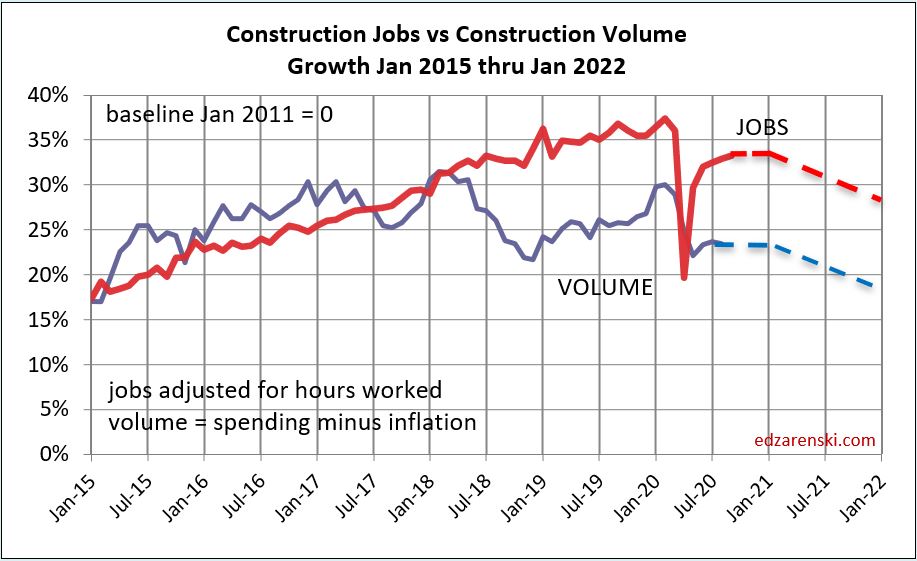
This is why the construction industry will have a hard time justifying growth in jobs. After 12 years of fairly even growth in jobs vs volume, that relation broke in 2018. Volume is currently at a 5-year low, well below jobs. Declining work volume is indicating by this time next year we may be down 600,000 jobs below the Feb 2020 high.
The following table shows which markets have the largest (and smallest) changes in new construction starts. With the exception of residential, due to longer durations, spending in all other markets is most affected by a decline in new starts, not in this year, but in years following. Residential spending hit bottom in May, will post an increase in 2020. Nonres Bldgs spending won’t hit bottom until 2022.
A recent AGC survey of construction firms asked the question, How long do you think it will be before you recover back to pre-Covid? The survey offered “longer than 6 months” as an answer choice. My current forecast is longer than 6 years.
Some effects have not even begun to show up in the data. A 20% decline in new nonres bldgs starts in 2020 means a huge decline in spending and jobs in 2021-2022. How long before construction returns to the level it was at in Feb? 6 to 8 years.
Many nonresidential buildings have durations that last 24 to 36 months, with peak spending 12 to 18 months from now. With the drop in new starts this year, that peak spending 12 to 18 months from now will be impacted. Some nonbuilding markets have project durations that go out 5 or 6 years, so the impact of a decline in 2020 starts may be felt at least until 2025.

If construction starts in 2020 do not outperform 2020 construction spending, then starting backlog Jan. 1, 2021 will be lower. My current forecast (starts down 11%) is indicating 2021 starting backlog will be down by almost 10%. Spending declines into 2021 and remains depressed through 2023.
The last time starting backlog decreased was 2011. Starting backlog will fall 10% in 2021 and 2% in 2022. Except for residential, about 80% of annual spending comes from starting backlog.
The next table shows spending year-to-date through August (released 10-1-20) and the spending forecast for the year. 2nd quarter construction spending activity low-point is down only 5.5% from the Feb peak. Construction spending in August YTD is up 4.2%.
Residential ytd is up 7.2%. Single Family is +3.0%, multifamily is +2.7% and renovations is Reno +15.6%. Nonresidential buildings ytd is down -0.3% and Nonbuilding Infrastructure ytd is +5.8%.
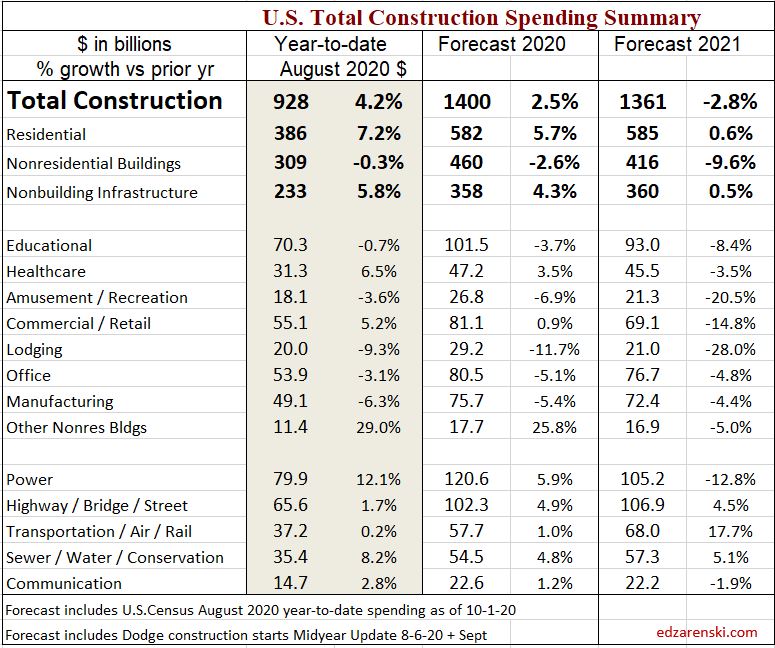
Take note here, the YTD spending for Nonresidential Buildings is currently -0.3% and my 2020 forecast shows Nonres Bldgs ending the year down -2.6%. Some forecasters are predicting spending for nonresidential buildings will end the year down much worse than -2.6% compared to 2019.
With only 4 months remaining, in order for Nonres Bldgs spending to finish down even -5%, the monthly rate of spending compared to 2019 would need to drop to -14%/mo for each of the remaining 4 months of 2020. (8mo x avg -0.3% + 4 mo x avg -14%) / 12mo = -5% total for the year. To end the year down -8%, nonres bldgs spending for the next 4 months would need to come in 25% lower than 2019. That’s “Great Recession” territory.
How unlikely is this to occur? The greatest monthly declines in 2020 so far are July and August in which the monthly rate of spending dropped -3% to -4% compared to same month 2019. Essentially, for nonresidential buildings spending to end the year down -5%, the bottom would need to drop out of the nonresidential markets, beginning back on Sept 1 and continuing for the final 4 months of the year.
Not sayin’ it can’t happen. This is 2020!


