Home » Construction (Page 2)

Category Archives: Construction

Spending Summary Construction Forecast Fall 2017

3-15-18 see also  2018 Construction Spending Forecast – Mar 2018

12-2-17

Summary

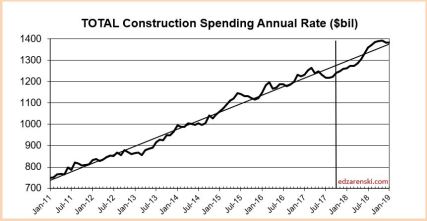
Total construction spending in 2017 will reach $1,236 billion, an increase of 4.2% over 2016. Residential spending is above 10% growth for the 5th consecutive year.

Year-to-date construction spending growth through October is 4.1%.

Residential leads construction spending growth in 2017 for the seventh consecutive year, up 10.6%. My Nonresidential Buildings forecast has been lowered since July but finishes the year up 2.8%. Only Non-building Infrastructure will not improve over 2016, down 3.7% for the year. However, Non-building Infrastructure has been at an all-time high for the previous two years.

Spend ALL 2011-2018 12-3-17

This forecast is down slightly since July due to reductions in both nonresidential buildings and non-building infrastructure. Educational, Office, Power and Highway, four of the five largest markets which together make up half of all nonresidential spending, were all lowered.  Some of these markets are prone to very large post-annual upward revisions and that has the potential to add to 2017 spending when those revisions are released in July 2018. In the July 2017 revisions, Power spending for 2016 was revised up by 10%.

History shows spending has been revised up 51 times in the last 55 months. I wouldn’t be surprised to see future revisions smooth out spending in unusually low periods (April and July) and increase total 2017 spending above this forecast. I suspect revisions in July 2018 may show 2017 spending as high as $1,250 billion. The average post-annual total spending revision for the last five years is +2.3%. The total revision to 2016 was only 2.2%.

None of the spending detailed in this analysis includes any projections of potential work from future infrastructure stimulus.

Total construction spending in 2018 is currently forecast to reach $1,334 billion, an increase of 8.0% over 2017. For the first time since pre-recession, Non-building Infrastructure will lead all spending with potential to increase by 10% growth over 2017.

Non-building Infrastructure is forecast to lead 2018 spending with an increase of 10.2% due to very large projects in Power and Transportation. Nonresidential Buildings growth is strong for 2018, forecast up 9.3%. Residential spending in 2018 slows to only 5.7% growth after six years averaging 13%/year.

Total spending will reach a new high in 2018 for the third consecutive year. However, in constant $ adjusted for inflation, spending is just back to the level of 2008. The all-time constant $ high was reached in 2005. Adjusted for inflation, 2018 will still be 12% below that level. At current rates of growth, we would not eclipse the previous high before 2022.

Spend Summary 2017-2018 Oct 2017 12-2-17

Growth of 8% in 2018 or $100 billion in construction spending demands a few words on jobs growth. Construction requires about 5000 workers for every added $1 billion in construction volume. Construction jobs have never increased by 500,000 in one year. However, $100 billion in added spending is not the same as $100 billion in volume, and jobs grow based on volume. Although spending will increase 8%, construction inflation has been hovering near 4.5% to 5% for the last five years. Real volume growth in 2018 after inflation is expected to be just over 3% or $40 billion. That would mean the need, if there are no changes in productivity, is to add about 200,000 additional workers in 2018, a rate of jobs growth that is well within reach since that is below the average jobs growth for the last seven years.

Residential Buildings Spending

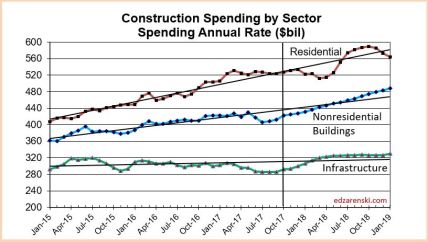
Total Residential spending in 2017 will finish at $523 billion, up 10.6% from 2016. Residential spending is above 10% growth for the 5th consecutive year.

Residential spending was expected to dip between May and October due to a low volume of work contributed from starts cash flows. The actual data shows, after reaching a seasonally adjusted annual rate (saar) of $536 billion in March, the high for the year, spending dropped 3% to 4% to as low as $515 billion saar three times and has averaged only $520 billion saar from April through October. New starts in Q1’17 reached an 11-year high, so I expect the rate of spending to increase at year end. Residential work will close out the year with 10.6% growth, the 5th consecutive year over 10%. Average growth the last six years is 13%/year.

Residential spending is 50% single family, 13% multi-family and 37% improvements.

Residential Improvements has posted 18% growth year-to-date. Single Family spending is up 9% while multi-family is up only 4%. That is compared to 2016 when improvements for the year finished up 10%, SF up 4% and MF up 5%. Census does not include flood damage repairs in improvements but does include full flood damaged structure replacements in improvements.

Total residential spending in 2018 slows to a forecast of $553 billion, only 5.7% growth over 2017.

Due to the shorter duration of projects, nearly 70% of residential spending within the year is generated from new starts. Unlike Nonresidential, backlog does not contribute nearly as much to Residential spending within the year. New Residential starts in Q1’17 reached an 11-year high. Residential starts are at a post-recession high.

Residential spending will reach a 12-year high in 2018. Adjusted for inflation, all years from 1996 through 2007 were higher. Inflation adjusted spending is still 30% below the all-time high reached in 2005.

Spend Sector 2015-2018 12-3-17 

Nonresidential Buildings Spending

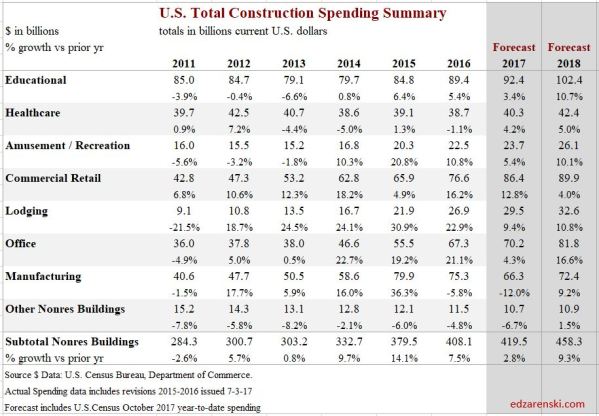
Total Nonresidential Buildings spending in 2017 will come in at $420 billion, up only 2.8% from 2016.

Commercial/Retail is expected to finish the year with +13% growth and Lodging +9%. An unexplained surprise was Office, which by early indicators was predicted to show large gains in spending. Two independent sources reported new office starts in 2016 up 25% to 30%. Starting backlog coming into 2017 was near or at an all-time high. Spending was forecast to jumped at least 20% in 2017. Instead, spending posted declines from May to September and is now forecast to finish with only a 4% gain. This market accounts for the single largest miss in my forecast posted in Feb 2017.

The only major nonresidential building in decline this year is Manufacturing. Manufacturing spending was expected to fall in 2017 after peaking in 2015 from massive growth in new starts in 2014. Spending stayed close to that level in 2016. Based on cash flows from starts, spending was expected to decline in 14 of the last 18 months. It declined in 11 of those months. We are at the point of turn-around with only one monthly decline predicted in the next three months and no spending declines expected next year. For 2017, Manufacturing new starts are up 35%.

Spend Nonres Bldgs 2017-2018 Oct 2017 12-2-17

Nonresidential Buildings starts in the six months from Aug 2016 to Jan 2017 posted the (then) highest amount of new starts since Jan-Jun 2008, also the year Nonresidential Buildings spending peaked. Then new starts in the six months Apr-Sep 2017 just surpassed both those previous peak highs.

Nonresidential Buildings 2018 starting backlog is 50% higher than at the start of 2014, the beginning of the current growth cycle. Starting backlog has increased for five years at an average 10%/year. Spending from starting backlog, up 10% in 2018, increased for five years at an average 9%/year.

Total nonresidential buildings spending in 2018 is forecast to reach $458 billion, an increase of 9.3% over 2017. Office, educational and manufacturing make up 70% of the growth.

Nonresidential Buildings will reach a new high for spending in 2018, surpassing the previous 2008 high. However, adjusted for inflation, spending is 18% below the all-time high reached in 2000.

Non-building Infrastructure Spending

Total non-building infrastructure spending in 2017 drops to $293 billion, down 3.7% from 2016.

Non-building Infrastructure spending, always the most volatile sector, dropped to yearly lows from June through September. Infrastructure construction spending in August dropped to the lowest since November 2014. However, this was predicted. Cash flow models of Infrastructure starts from the last several years show current dips in monthly spending are being caused by uneven project closeouts from projects that started several years ago.

Current backlog is at an all-time high and spending will follow the expected increased cash flows from the elevated backlog. Environmental Public Works (Sewage/Waste disposal down 16%, Water Supply down 9% and Conservation/Dams & Rivers down 7%) posted the largest declines in 2017 and accentuated the declines in the infrastructure sector. The sector is expected to increase slightly in the last quarter 2017. In recent months there are already substantial gains being posted in Conservation and Transportation.

No future growth is included from infrastructure stimulus and yet 2018 is projected to increase by 10%.

Spend Infra Jan15 to Jan19 12-2-17

Total non-building infrastructure spending in 2018 is forecast to reach $324 billion, an increase of 10.5% over 2017. My forecast for 2018 is predicting every infrastructure market will post gains, but it is the Power and Transportation markets that account for almost all the growth in 2018. Transportation new starts in 2017 grew 120% due to massive new air terminal and rail projects. Spending growth in the Power market is not quite so apparent. Combined Power new starts are down for both 2016 and 2017, but the spending gains are coming from projects that started in 2015, a year in which starts were up over 120%.

Non-building Infrastructure will reach a new high for spending in 2018. This sector had posted a new high in 2015 and nearly equaled that in 2016. Adjusted for inflation, spending in 2018 will be nearly equal to the all-time highs reached in 2015 and 2016.

Spend Nonbldg Infra 2017-2018 Oct 2017 12-2-17

Public Spending

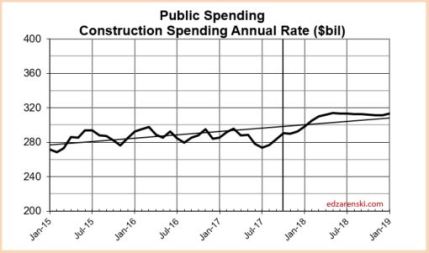
Total public spending for 2017 remains flat at $287 billion with most major public markets down for the year.

At midyear, I expected Educational and Highway to support a Public spending increase in 2017. Those gains did not materialize. A decline in Highway spending offset small gains in Educational.  By far the largest Public spending decline is in Sewer and Waste Disposal, down 16%.

Public spending hit the low for the year in July. It increased for the last three months, most recently by an 11% increase in Public Educational spending in October.  We are now near the high for the year and can expect to see another six months of growth before spending levels off in mid-2018.

Spend Public Only 2015-2018 12-2-17

When you see graphics that present Residential, Nonresidential and Public spending all on the same plot, they are not additive. Only Residential and Nonresidential can be added to reach total spending. Public is a subset of Nonresidential, composed partly of Nonresidential Buildings (~40%) and partly Non-building Infrastructure (~60%), with a slight amount of residential.

The two largest markets contributing to public spending are Highway/Bridge, 32% of total Public spending, and Educational, 25% of Public spending. The third largest market, Transportation, is only about 10% of Public spending.  Environmental Public Works combined makes up almost 15% of public spending, but that consists of three markets, Sewage/Waste Water, which accounts for 8%, Water Supply and Conservation. Office, Healthcare, Public Safety and Amusement/Recreation each account for about 3%.

All of Highway/Bridge is Public spending. Only 80% of Educational spending is Public and only 70% of Transportation is Public. Environmental Public Works markets are 99% Public.

Spend Public-Private 2017-2018 Oct 2017 12-2-17

Total Public spending in 2018 is forecast to reach $305 billion, an increase of 6.3% over 2017. Public spending in 2018 will reach the highest year over year growth since 2008.

Educational and Transportation will contribute equally and together account for almost 60% of the Public spending growth in 2018. Transportation new starts in 2017 grew 120% due to massive new air terminal and rail projects. Educational new starts total for the last three months posted the highest quarter in at least seven years. The 2nd highest quarter was also within the last 12 months, so still contributes fully to 2018 spending. 2018 signifies a turn-round in Public spending which has not posted significant growth since the recession.

See this companion post for  Starts Trends Construction Forecast Fall 2017  11-8-17

After New Starts, dollars are tracked in Backlog, Backlog Construction Forecast Fall 2017  11-10-17

For more on Jobs and Workload see Construction Jobs / Workload Balance 11-7-17 

For effects of inflation see Constant Dollar Construction Growth 11-2-17

What Are You Reading 2016

Thank you to all my readers for making this construction economics blog worthwhile. Here’s ten of my most visited articles in 2016.

Construction Cost Inflation – Midyear Report 2016

Construction Inflation Indices

Trump’s Wall

Starts Point to Robust 2017 Spending

June Jobs Report Construction

Construction Spending 2016 – Midyear Nonresidential Markets

Construction Spending 2016 – Midyear Summary

How Much Does A Steel Cost Increase Affect Construction?

Saturday Morning Thinking Out Loud #1 – Infrastructure

Behind The Headlines – Construction Data

Construction Spending 2016 – Midyear Summary

Summary 2016 Construction Spending

9-7-16

Total Construction Spending for July reached a seasonally adjusted annual rate (SAAR) of $1.15 trillion, level with June which was revised upwards by $20 billion or nearly +1.8%. Monthly spending always gets revised in subsequent months. This year every month but May, which remained nearly unchanged, has been revised upwards, by an average of +1.4% and as much as 3.4%. Monthly values are subject to revision for two months after the first release and once again in May of the following year.

This plot, Construction Spending vs New Starts Cash Flows, shows actual spending (SAAR) by sector through July 2016 and projected trends of spending out to July 2017.

starts-vs-spending-9-7-16

Previously I wrote that we should expect a short duration downturn in spending occurring between January and March. The expected monthly spending cash flows that would be generated from uneven new starts over the last two years indicated that a slowdown in spending would occur during the first quarter 2016. As it turns out, first quarter spending was much stronger than expected, averaging $1.17 trillion SAAR, primarily due to outstanding results in February and March for residential spending. But then April and May experienced significant declines, dropping to an average of only $1.14 trillion SAAR, down almost 3% from Q1. Now with June and July spending both up 1% from the April and May lows, it looks like we may be past that short duration downturn.

Total Construction Spending year-to-date (YTD) through July is up 5.6% over the same seven months 2015. Spending slowed in April and May from a 1st quarter average of $1.17 trillion that reached close to a 10 year high and falls just 4% short of the all-time high. However, it must be noted, that compares unadjusted current dollars, values of all dollars current in the year spent.

When comparing inflation adjusted constant dollars, all dollars adjusted to the same point in time, we can see 2016 spending is still 18% below the 2006 highs.

spend-current-vs-constant2016-plot-apr2016

Total spending YTD through July is slightly ahead of what I predicted back in December, but it’s slightly below what I expected for May, June and July . I expect 2nd half spending to average above $1.2 trillion SAAR, but slightly lower than I originally forecast.

I’ve revised my 2016 spending forecast down slightly to total $1.190 trillion, up 7% from $1.112 trillion in 2015.

How does actual spending YTD compare to my prediction at the beginning of the year?

  • Total predicted YTD through July $638.2b,  actual YTD $647.7b (+$9.5bil, +1.5%).
  • Residential predicted YTD $245.1b,  actual YTD $259.2b (+$14.1bil, +5.8%).
  • Nonresidential Bldgs predicted YTD $236.9b,  actual YTD $228.1b (-$8.8bil, -3.7%).
  • Non-building Infrastr predicted YTD $156.2b,  actual YTD $160.5b (+$4.3bil, +2.8%).

Where are the revisions?

The single largest reduction in spending is in Nonresidential Buildings Manufacturing. Although there are other variances, that could account for the entire revision downward. Predicted construction starts for Manufacturing was lowered by nearly 35% after the initial start-of-year forecast was made.

Non-building Infrastructure spending increase is being supported by a 20%+ increase in power, which I didn’t expect. New starts for power projects have increased more than 20% since the initial forecast.

Residential construction had unusually large gains in February and March, almost all of that in residential renovations, offset only partially in April through July by declines mostly in new single-family housing.

Here’s my revised 2016 spending forecast based on YTD spending and new construction starts through July, compared to my prediction in December 2015.

  • Total predicted Dec 2015 $1,206.2b,   July 2016 $1,189.9b (-$16.3bil, -1.4%).
  • Residential predicted Dec 2015 $473.8b,   July 2016 $481.8b (+$8.0bil, +1.7%).
  • Nonresdntl Bldgs predicted Dec 2015 $439.2b,   July 2016 $410.9b (-$28.3bil, -6.4%).
  • Non-bldg Infrastr predicted Dec 2015 $293.2b,   July 2016 $297.3b (+$4.1bil, +1.4%).

Spending and construction starts are often confused by some analysts who refer to starts data as spending. Starts represent total project value recorded in the month the project begins. To determine spending activity, starts values must be spread out over the duration of the projects. Spending is dependent on cash flows each month generated from all previous construction starts. Cash flows expected based on Dodge Data construction starts are indicating a return to growth in spending in the 2nd half 2016. (See chart above Index Actual Construction Spending vs New Starts Cashflows).

starts-vs-spending-table-9-8-16

Spending Breakout by Sector

Residential  construction spending for July totaled a SAAR of $452 billion, remaining near level for the last four months. Residential spending YTD through July is up 6.5% over 2015. Spending slowed in April and May from a very strong 1st quarter average that reached close to a 10 year high. The current 3-month average is just 1% below the 1st quarter and is still at its highest since the 2nd half of 2007 but is 10% below the current dollar all-time high in 2006. I’m still expecting some upward revisions to June or July residential spending.

Residential spending just experienced the strongest three-year stretch of spending growth on record, up 60% in 2013-2014-2015. After taking out inflation, volume growth was only 31%, but that is still the strongest ever for three consecutive years. Spending growth in 2016 will reach only +9%. After adjusting for inflation that represents volume growth of less than +4%, the slowest in 5 years. New starts YTD (as reported by Dodge Data) although down from the 1st quarter, are still near post-recession highs. Starts from late 2015 and early 2016 will still be generating spending into early 2017. 2017 will repeat nearly identical to 2016. What we may be seeing is that it might be difficult to register another year of very high percentage growth in 2016 or 2017 because it is being measured against the 2015 10-year high. Another factor limiting very high growth may be a limited supply of labor to expand the workforce.

Total Nonresidential SAAR spending for July is $701 billion, down slightly from June, but monthly SAAR has varied only +/- 1% for the last six months. YTD spending compared to 2015 is up 5.1%. Nonresidential spending also slowed in April and May but is now up 1.5% from those lows. The current 3-month average is up slightly from the 1st quarter and is just 3% below the pre-recession 2008 current dollar high.

Nonresidential Buildings spending for July totaled a SAAR of $403 billion, down slightly from June but up 1.3% from the May dip. Spending YTD for nonresidential buildings through July is up 8.0% over 2015. The current 3-month average of $403 billion is up slightly from the 1st quarter but is still 9% below the peak in 2008.

Non-building Infrastructure spending for July fell to a SAAR of $289 billion, down only slightly over for the last four months. YTD spending through July is up only 1.3% over 2015. Spending began to slow in April and May and is now at the 2016 low. The current 3-month average is down 4% from the 1st quarter. However, spending on nonbuilding infrastructure reached an all-time high in the first half of 2014 and has remained near those highs through 2015 into the 1st quarter of 2016.

9-7-16

Public spending average for the 1st six months of 2016 is the highest since 2010 and is up 10% from the 2014 low point. YTD public spending is up 0.2% from 2015. All of Highway plus 80% of Educational makes up 55% of all public construction spending. The next largest markets, all of Sewage/Wastewater plus 70% of Transportation accounts for only 19% of public sending. All other markets combined make up less than 20%.

The biggest mover to total public spending this year is educational spending. Public educational spending is up only 4.0% YTD, but because it represents almost 25% of all public spending, it’s has a bigger net impact of +1.0% on moving the trend up than any other single public market. Public commercial spending is up 36.6% YTD but has only a 1% market share of public work. Highway and street is up 2.6% YTD. At 30% of total public that results in a net move of +0.8%. Office, public safety, power, sewage/waste disposal and water supply are all down YTD by a combined -5.3%. At a combined market share of 21% that nets a -1.1% reduction in YTD public spending.

Private spending is dominated by a 52% market share of residential work. At 6.6% growth that nets 3.4% growth in private spending. Several of the nonresidential building markets have high YTD growth (and/or a large market share of private work); lodging +30%, office +27%, Amusement +22%, commercial +10% and power +8%.  These five markets combined represent 29% of private spending and combined are up +15% YTD for a net impact of +4.4% to private work.

For a base of reference, here’s a few points in spending history.

Total Construction Spending

  • 8 years 1998-2005 up 77%
  • 3 years 2003-2005 up 32%
  • 3 years 2008-2010 down 30%
  • 4 years 2012-2015 up 41%

Residential

  • 8 years 1998-2005 up 133%
  • 3 years 2003-2005 up 57%
  • 3 years 2007-2009 down 60%
  • 3 years 2013-2015 up 60%

Nonresidential Buildings

  • 5 years 2004-2008 up 64%
  • 3 years 2006-2008 up 45%
  • 3 years 2009-2011 down 36%
  • 2 years 2014-2015 up 25%

Non-building Infrastructure

  • 7 years 1995-2001 up 56%
  • 4 years 2005-2008 up 60%
  • 3 years 2009-2011 down 8%
  • 3 years 2012-2014 up 19%


See this post for expanded details on Construction Spending – Nonresidential Markets – Buildings and Infrastructure

See this post for expanded details on Construction Inflation

Trump’s Wall

5-22-16  updated 1-7-19

Trump’s Wall

Recently I received a call from a major national news source. They asked for help understanding what it would take to build “Trump’s Wall.” I’m an estimator, so I provided some realistic analysis of what it would take.

The border with Mexico is almost 2000 miles long. There is already about 700 miles of fence. This analysis makes an assumption it would be necessary to build only 1000 miles of wall. Also, this estimate is based on the type of wall you see along highways, precast concrete sound and site barrier wall. In reality it would need to be significantly more robust than the typical highway sound-barrier wall, and I’ve taken that into consideration in my estimate. So here goes.

(9-1-16 >>In some other recent articles I’ve read they have suggested a 40 foot high concrete wall. Well, I don’t think you can build a 40 foot high unsupported concrete wall (no bracing at sides) without getting into extremely massive volumes of materials. Such a high concrete wall would need to be much thicker at the base than at the top and the foundation to prevent overturning would need to be massive. Typical rule of thumb for foundation to prevent overturning is the foundation needs to be ~40% as wide as the height of the wall. The volume of concrete would be 4x to 5x what I’ve estimated for the wall I’ve defined here and the excavation, back fill and formwork would add considerable time to complete. Order of Magnitude I guess 40 to 50 million cubic yards of concrete for wall and foundation. I would roughly guess such a massive poured concrete foundation and wall, if it could even be built, would cost THREE TO FOUR TIMES what I’ve estimated here and would require substantially more labor and might take twice as long or more to build.)

This estimate is based on 8″ thick precast heavily reinforced  concrete wall panels set between steel columns 12’0 on center. Even if the concrete could be chipped away, the reinforcing bars would prevent passage. Columns are set in 6’0 dia. x 10’0 deep column foundations. Between column foundations under the wall is a continuous footing to help resist overturning of the wall. The wall extends 25 feet above grade and 5 feet below grade. Bottom of concrete footing under the wall is 7’0 feet below grade. Bottom of column foundations is 15’0 below grade. The wall would be much higher than the approximate 12′ shown in the representative photo.
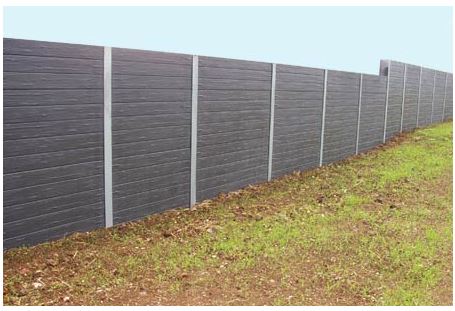
wall-11-11-16

The foundations included here are based on up-sizing components from a known design for a 15′ high prison un-climbable open-mesh fence. Even with an open mesh fence design, to overcome wind load, column footings were 2″0″ dia x 8’0″ deep concrete post foundations set every 8′ apart. This solid wall 25′ high would have enormously greater wind loads and it is the foundation that must be designed to prevent overturning.

Just to get quickly to the end, I calculated the final cost of a 25′ high precast wall, foundations, excavation and access roads in the vicinity of $25 billion (in 2016 $), $10 million per mile or slightly less than $2,000 per lineal foot of wall. I’m fairly certain this estimate is somewhat low and the actual cost due to the many unknowns would be higher. At the end I’ve pointed out some of the issues that could generate unknown costs.

One huge factor is inflation. Historical average construction inflation is greater than 4%/year. If a $25 billion wall takes 10+ years to build, the total cost over time assuming the historical average construction inflation would be $30 billion.

This is a summary of some of the results from the concrete wall estimate.

Materials
200 million square feet of precast concrete panels = 5.2 million cubic yards of concrete
5 million cubic yards of cast-in-place concrete foundations
Total cement to make the 10.2 million cubic yards of concrete = 2% of annual US cement production.
1.5 million tons of steel = 1.5% of annual US steel production.

25 million cubic yards of excavation required.
6 million cubic yards of that excavated earth must be hauled away and disposed since that volume will be replaced underground with concrete. That’s more than enough to completely fill the Superdome. Or, it’s enough to build a 20 foot wide earthen embankment 20 feet high and 100 miles long.

Delivering the Materials
250,000 truckloads of precast wall panels,
500,000 truckloads of ready mix concrete
50,000 truckloads of steel

200,000 truckloads to haul away excess excavated earth.

This is far from a complete list of materials, because in addition to building the wall, in some places you first need to build a road. Assume about 500 miles of road. You can’t get 1,000,000 truckloads of 30-40 tons each, cranes, excavators and auger drills to a construction site without at least building a compacted gravel road to get there.

Adds 2 million cubic yards of stone for construction equipment road.

Adds 100,000 truckloads of stone

Labor
It takes 5000 to 6000 workers to build $1 billion worth of construction in 1 year.

$25 billion x avg 5500 = 135,000 man-years, or 135,000 workers if it is to be built in 1 year. Or it would take 10,000 full-time workers 13.5 years to build this concrete wall.

If 1,000 men worked on the wall 5 days a week 8 hours a day, it would take 135 years to build it. Therefore, I made the assumption the project would be broken into 50 segments each 20 miles long and looked at two scenarios. What labor would be required to build it in 10 years or 4 years?

4 years: That will require 700 men AT EACH of 50 SEGMENTS concurrently to complete the wall in 4 years. That’s 35,000 men working for 4 years. That is 35,000 trades-worker jobs which does not include Architect, Engineering, Testing and General Contractors management personnel.

1,100,000 truckloads at 50 locations over 4 years is = 20 deliveries per day of 30 to 40 tons each at each of the 50 locations. That works out to 40 truck bypasses per day coming and going, so 30 ton trucks go by (some community) every 12 minutes at every one of 50 locations every workday for 4 years. It is very likely that heavy truck traffic will destroy many if not all the town roads used to access the 50 construction sites. The cost to repair/replace those existing roads is NOT included here, but I suspect it would be in the hundreds of millions.

The 4 year scenario is quite unlikely from just about every standpoint. Labor availability, engineering studies and site preparation of 50 (or more) job sites, mobilization of 35,000 men to 50 job sites, product supply, frequency of deliveries, overcrowding of job site. In reality, 700 men at a job site is probably far more than can be managed. In this scenario the number of job sites would need to be increased, probably to more like 150 to 200 individual job sites. While all aspects seem to limit this choice as viable, it is probably labor and material availability that would have the greatest impact.

10 years: To build the wall in 10 years would require 13,500 workers, or about 250 workers AT EACH of 50 SEGMENTS concurrently to complete the wall in 10 years. That’s 13,500 workers working for 10 years. That is 13,500 trades-worker jobs including General Contractors management personnel but not including Architect, Engineering, Testing, Manufacturing and Delivery.

1,100,000 truckloads at 50 locations over 10 years is = 8 deliveries per day of 30 to 40 tons each at each of the 50 locations. That works out to 16 truck bypasses per day coming and going, so 30 ton trucks go by (some community) every 30 minutes at every one of 50 locations every workday for 10 years. The same heavy truck traffic will destroy many if not all the town roads used to access the 50 construction sites, it just takes longer. The cost to repair/replace those existing roads is NOT included here.

The 10 year scenario is certainly not impossible. Labor availability and mobilization issues are reduced as are product supply and frequency of deliveries.

NOTE 1-7-19  New review of proposed steel barrier changes some materials and has a moderate overall affect on total cost, manpower and time to complete. In question is size of steel section that could withstand installation 25′ to 30′ tall unsupported. For a steel barrier estimate I used tube steel hollow structural sections (HSS) 8x8x3/8 set with 6″ spaces between. The summary from the estimate revises precast panels to 3 million tons of steel. The remainder of the summary is still valid. It changes a little. Total cost came in near $24 billion versus the original estimate for precast concrete wall at $25 billion. However if design would require a heavier section 8x8x1/2 then cost jumps to $29 billion. If design requires concrete filled tubes cost would go up by about $750 million. If 8×8 tubes are rotated 45 degrees, spacing can be reduced and open spaces between tubes can be reduced, steel cost would go down by about $1 billion. Foundation cost may or may not be reduced (by as much as $2 billion), but foundation design to prevent wall overturning is more dependent on wind load than on the weight of the steel above. In any case foundations are massive and still calculate out to about 5-6 million cubic yards of concrete and proximity of concrete batch plants to construction zones could be a major issue. Keep in mind none of this cost includes land acquisition, inflation, housing workers, change orders or building new plants to support job sites with materials.

Best case scenario, at the low end of cost at $22 billion, it would take 10,000 men 11 years to build 1000 miles of steel fence barrier.  It is likely that the low end estimate is much to optimistic, citing some issues outlined below.

wide fence

A word about HSS steel tubes. US annual production for Hollow Structural Sections in 2016 was 1.6 million tons per year. That annual demand does not go away if 3 million tons of tube steel is needed for a wall. Over a period of 10 years, at 0.3 million tons/year, steel needed for a wall would be 20%/year of tube steel production. To prevent shortages, production capacity must increase or that extra tube steel must be imported. The US imports about half of all the steel pipe and tube is uses in a year from South Korea, but most of that is oil industry pipe. Manufacturing mills typically cannot increase capacity by 20% in a year. So, this extra demand for tube steel would either cause shortages or increase imports. 

Energy cost just to produce 3 mil tons of steel is enough to power 500,000 homes for 1 year. Energy to produce both steel and concrete probably more than doubles that number.
The money spent is enough to build 70,000 new homes or 500 new high schools.
Gasoline just for all truck deliveries is near 5 million gallons.

The concrete and steel materials gross to 2% of annual US cement production and 1.5% of annual US steel production (for a precast wall), but that represents close to 3% of steel used in construction. (The revised steel barrier reduces precast but increases the steel to 4% of US steel production. It represents 200% of annual tube steel production). About half of all US steel goes into your refrigerators, cars, etc., the other half goes into construction. The materials demand has far more affect than you might think on disrupting normal construction flow. Since it is all localized in one area of the country, the far southwest border, it could potentially represent 20% and 30% of the construction materials capacity in that area of the country, straining the capacity in that area and disrupting the normal volume of construction there for years. This would be detrimental to the rest of the construction industry growth in that area for that period.

This does not address the fact that manufacturing facilities to produce and fabricate the steel and deliver concrete needed at each of the 50 work sites ideally should be spread along this 1000-mile corridor, which is very unlikely. In fact, I suspect it more likely that some locations will not be in close proximity to a materials source, the result either driving cost up or extending duration beyond 4 years, or both. It could require building process plants along the path, for instance, ready-mix concrete batch plants and steel fabrication yards.

The time necessary for land acquisition, design, permitting, environmental study, mass material procurement, construction process planning and mobilization would be many months before construction begins. Although labor availability and the number of sites determines construction duration, 4 years would be a reasonable estimate for construction ONLY IF the 35,000 trades-workers needed can be mobilized simultaneously to 50 job sites, but that is not likely. The 4 years of construction starts when planning, design and permitting are complete. That might take 6 to 12 months.

Construction is experiencing what may be the tightest labor market in over 20 years. Since there are few if any available workers to shift to these new job site locations, we would need to assume much of this work is supported by creating nearly 35,000 new jobs. I looked at the Bureau of Labor Statistics Jobs for metropolitan areas within 100 miles of the border. Several serious problems arise.

In this localized area of the country, along a 1000 mile long 100 mile wide strip, 35,000 construction jobs could potentially be 12% to 15% and possibly as much as 20% expansion of the construction workforce. The maximum 30 yr historical rate of annual construction workforce expansion is 6% nationwide. Normal annual jobs growth is 3% to 4%/year. If one project were absorbing all of the jobs growth in an entire region, there would be no workers available in that region for any other construction activity growth for several years. That’s a major disruption to the local economies of several states.

Such an expansion would be extremely difficult to implement that quickly. The mobilization of 35,000 workers could take a very long time from initial ramping up to full employment, therefore extending the duration to complete the job. Many of these workers could be inexperienced adding further to the project duration. So reaching completion of this work with 35,000 workers would probably take much longer than 4 years. Adding time for planning and more time for ramping up labor, it could be 6 years.

Ramping up then down will soften the blow as the jobs begin to disappear at project completion. It could be pretty hard to generate enough new volume of work to keep all those men working. It will take new volume of $5 billion to $6 billion a year to keep all these workers working.

There’s a great deal to consider about the demand on the workforce to build a border wall, or fence. Let’s look just at Texas. In Texas, there are a total of 775,000 construction workers, the 2nd largest construction workforce in the country next to California. But checking all the major metropolitan statistical areas within 200 miles of the border there are only about 100,000 construction workers. Only about 20% of those workers conduct business in earthwork, concrete and steel, the trades required to build this fence. That’s only 20,000 workers available within 200 miles of the border.

Furthermore, the Texas/Mexico border is 1,250 miles long. If 20,000 workers were spread out evenly along the border (which is most certainly not the case), within any 200 mile stretch and within 200 miles inland, there would be only 3,200 available workers. In some well-populated areas there might be double that, approximately 6,000 workers, but in the less populated areas, there are far less than 3,000 workers within 200 miles of a proposed work zone.

Now let’s assume we need enough workers to build 100 miles of steel fence, somewhere within a 200-mile length and near a well populated area. That’s $2.5 billion of fence. We know that it takes about 5,000 workers a year (5,000 worker-years) to put-in-place $1 billion of construction. So, we need to fill 12,500 worker-years or job-years. That could be 12,500 jobs for 1 year or 1,000 jobs for 12.5 years. How many jobs get filled determines how long it will take to build 100 miles of fence. Well, there are nowhere near enough workers to fill 12,500 jobs to build 100 miles of fence in one year along many sections of the border. In the best case, most of 6,000 workers need to be accommodated with living quarters somewhere along a 200-mile stretch and 12,500 work/years divided by 6,000 available workers means it would take a little over 2 years to build 100 miles of fence.  

So, 100 miles of fence would take over 2 years to build, ONLY IF this project could absorb every single available worker in these trades within 200 miles for a period of two years. At the same time, for that 2-year period, there would be no available workers in sitework, concrete and steel trades anywhere else within 200 miles to fill all other normal workload. In less populated areas with only half as many workers available, it would take twice as long, or more.

This brief analysis of cost and constructability does not begin to address issues such as, how would a wall be built anywhere along the 1,000 miles of the Rio Grande river, the border between Texas and Mexico, the 4th largest river in the United States. Assuming such a wall must be built on US soil,  a wall would then completely cut off river access from the United States? Or, how would a wall be built through the hundreds of miles of national parks and national wildlife refuges along the border without disrupting natural wildlife migration flow? And, how would it be designed along its 1,000 mile corridor to accommodate drainage across a solid impervious barrier? It seems impractical or at the very least massively environmentally disruptive.

You can see, the logistics would be enormous, impediments loom, adjacent communities would be adversely impacted, the cost is probably far more than the $25 billion estimated and it seems highly unlikely this could ever be completed during the course of a single president’s term.

link to Washington Post interview 1-9-19

link to CNBC interview 1-24-19

1st Quarter 2016 Construction Spending and Forecast

5-2-16  March construction spending was released today.  Spending is UP 9.1% year-to-date vs 2015

Year-to-date gains are led by nonresidential buildings  up 11.3%, followed by non-building infrastructure up 8.6% and residential up 7.5%.

Construction Spending by Sector Jan2013-Apr2017 Mar 2016

This plot, Construction Spending By Sector, shows actual spending (SAAR) through March 2016 and projected spending to April 2017.

The biggest percentage growth year-to-date gain is multifamily housing ,up +31%, although Residential combined is up only 7.5%. Other growth, Lodging +30%, Office +22% and Highway +21%.

  • Residential year-to-date spending:
  • $ volume changes; SF +11.2%, MF +31%, Reno -7.3%.
  • Market share; SF 55%, MF 16%, Reno 29%.

The biggest $ volume gain through March is Residential +$6.4b, which includes a decline in renovation work. Single Family is up +$5.0b and Multifamily is up +$3.4B. Office +$2.6b, Highway +$2.5b and Educational +$2.1b. Although lodging is up 30%, its market share is small and its $ volume is up only $1.3b.

Residential spending has completely recovered from a 4% decline in January. Projected growth of 20% from now through the 4th quarter will help residential spending reach a total 15% growth for 2016.

Nonresidential buildings spending climbed 4% in the last two months from the stalled range that remained nearly flat from May 2015 through January 2016. Growth may peak this year in the 3rd quarter before dropping into year end, but may still reach a total 12% growth for 2016.

Infrastructure spending has meandered along the $300 billion mark since last May and is expected to stay there through 2016. Expect only slight growth of 4% in infrastructure spending in 2016, contributed mostly by Highway and Street.

All sectors may experience a decline in spending before year end, but all are expected to return to growth leading into 2017.

Total construction spending in 2016 should reach $1.220 trillion, up 11% from 2015. 2014 through 2016 will be the strongest 3-year growth on record in both percentage gain (+34%) and $ volume gain (+$314 billion). Only 2003-04-05 comes close.

Later, a comparison of inflation adjusted (constant) dollars. The results will be different. I’m estimating particularly high rates of inflation, so inflation reduces the gain in real constant volume from the spending projections by a lot in 2016. 


Construction Volume Vs Construction Spending

Construction volume is not the same as construction spending.

Spending vs Volume 1994-2015

Spending is the number nearly everyone follows. Volume is spending minus inflation.

Two years that show the greatest differences between spending and volume highlight the affect of inflation. In 2004 and 2005 total construction spending grew by 11% and 12.5%, but after inflation, volume grew by only 3% and 2%. In the most recent year, construction spending in 2015 grew by 10.5% but total construction volume grew by only 7.5%.

For the four years 2012 through 2015 construction spending grew by 35% but after inflation volume grew by 21%. Inflation accounts for 14% of spending growth.

Annual construction inflation varies for residential, nonresidential buildings and nonresidential infrastructure, and it varies sometimes so widely that each should be used only to adjust that specific group. Since 1993, long-term annual construction inflation for buildings has been 3.5% per year, even when including the recessionary period 2007-2011. During rapid growth periods, inflation averages more than 8% per year.

Historical average volume growth over the last 22 years is grossly distorted by the recession. Volume declined in 8 of those 22 years.  In the worst three years of the recession, 2008, 2009 and 2010, volume declined by 28%. If we take out those three years the typical growth period averages are more apparent. The historical average volume growth in construction with recession data removed and after adjusting for inflation is 2% per year for 19 years.

Adjusting for inflation is changing current dollars to constant dollars.

Current dollars = dollars are reported in the value of the year reported, 2008 = 2008$, 2015 = 2015$.  News reports almost always refer to current dollars and therefore do not account for the influence of inflation.

Constant dollars = all dollars adjusted to represent dollars in the year of comparison. This adjusts for inflation so 2008$ (and all other years) are converted to equivalent 2015$.

It’s not too hard to understand why we need to look at constant dollars when you think of it in terms of building a house. For example, a 2,500 sf house built in 2001 may have cost $250,000 then to build. Today to build that exact same house may cost $400,000. The house is no different, so volume remains the same. The only thing that changed is inflation. With respect to constant dollars for the same volume, $250,000 in 2001 dollars would be equal to $400,000 in 2015 dollars.

The common comparison is to look at growth in construction spending from year to year. What that does not tell us is how much of the spending growth is inflation and how much is a real increase in construction volume.

Spend current vs constant2015 22pct volume growth

Constant dollars makes a huge difference in the analysis. Adjusting all previous years of spending allows us to compare changes in volume growth from year to year. This plot of total construction dollars shows current dollars would indicate we are now only 7% below the previous high and we’ve had growth of 37% from the recession low.  Constant dollars, adjusting for inflation, shows volume is still 17% below the previous cycle high and we’ve had growth of only 22% since the recession lows.

Construction Forecast 1st Look – What To Expect in 2016?

Construction spending may reach historic growth in 2016.

There are currently six estimates available forecasting 2016 total construction spending ranging from 6% to 10% growth, with an average of 8.7%. My forecast is 9.7%.

Total construction spending, forecast to grow 9.7% in 2016, could reach a total 30% for the three years 2014-15-16. The only comparable periods in the last 20 years are 29% in 2003-04-05 and 27% in 2013-14-15.

The current nonresidential buildings construction boom could become an historic expansion. Nonresidential buildings spending is forecast to grow 13.7% in 2016. Added to 8.8% in 2014 and 17.1% in 2015, the three-year total growth could reach 40% for 2014-15-16. The only comparable growth periods in the last 20 years are 40% in 2006-07-08 and 32% in 1995-96-97.

For perspective, residential spending increased 46% in 2013-14-15, similar to only one comparable period in the last 20 years, 48% in 2003-04-05.

Non-building infrastructure projects, in two of the last three years have barely shown any gains entirely due to declines in power plant projects. This will repeat in 2016.

This is still the 1st or 2nd most active 3 year period of growth in construction in more than 20 years, and it’s already been ongoing since 2013-2014. With the forecast for 2016, spending growth could reach a new three-year high.

From the middle of Q1 2016 to the end of Q3 2016, total spending will post six to eight months at an annual growth rate of 20%, but due to the dips at the beginning and the end of the year, total 2016 construction spending will finish at 9.7% growth. Construction spending momentum is not yet losing steam. We may be seeing the effects of a few years of erratic growth patterns and a shift from more rapidly changing commercial and residential work to slower growth institutional work.


Index of Actual Spending and Starts Cash Flows 2012-2017

Residential spending will slow several percent early in 2016 before resuming upward momentum to finish the year with 12% growth, slightly less than growth in 2014 and 2015. Periods of low new start volumes need to work their way thru the system and this produces growth patterns with periodic dips. The upward momentum will carry into 2017.

Nonresidential buildings spending will slow moderately in the next few months before we see a 15% growth rate through the middle of the year, only to see another slowdown late in 2016. Major contributions are increasing from institutional work in educational and healthcare markets. Office, commercial retail, lodging and manufacturing will decline considerably from 2015 but still provide support to growth.

Infrastructure projects spending will decline over the next six months due to the ending of massive projects that started 24 to 42 months ago. There will be large advances in spending midyear before we experience another slowdown later in 2016. Following a 0.5% increase in 2015, spending will increase only 1.2% in 2016, held down by a 10% drop in power projects, the second largest component of infrastructure work.

Construction added 1.0 million jobs in the five years 2011-2015.  800,000 jobs were added in the last three years. To support forecast spending, jobs need to grow by 500,000 to 600,000 in 2016-2017. Growth in nonresidential buildings and residential construction in 2014 and 2015 led to significant labor demand which has resulted in labor shortages in some building professions. Demand in 2016-2017 will drive up labor cost and may slow project delivery.

Spending growth, up 35% in the four-year period 2012-2015, exceeded the growth during 2003-2006 (33%) and 1996-1999 (32%) which were the two fastest growth periods on record with the highest rates of inflation and productivity loss. Construction spending growth for the period 2013-2016 is going to outpace all previous periods.

Construction inflation is quite likely to advance more rapidly than some owners have planned. Long term construction cost inflation is normally about double consumer price inflation. Construction inflation in rapid growth years is much higher than average long-term inflation. Since 1993, long-term annual construction inflation for buildings has been 3.5%, even when including the recessionary period 2007-2011. During rapid growth periods, inflation averages more than 8%. 

For the last three years the nonresidential buildings cost index has averaged just over +4% and the residential buildings cost index just over +6%, however, the infrastructure projects index declined. The FWHA highway index, the IHS power plant index and the PPI industrial structures and other nonresidential structures indices have all been flat or declining for the last three years. This provides a good example for why a composite all-construction cost index should not be used to adjust costs of buildings. Infrastructure project indices often do not follow the same pattern as cost of buildings.

Anticipate construction inflation of buildings during the next two years closer to the high end rapid growth rate rather than the long term average.


2016 Construction Outlook Articles


Articles Detailing 2016 Construction Outlook

Links will open in a new tab

These links point to articles here on this blog that summarize end-of-year data for 2015 and point to articles with projections for 2016.

Most Recently Published

Summary of 2017 Construction Outlook 2-21-17

How Much Does A Steel Cost Increase Affect Construction? 9-18-16

Trump’s Wall

2015 Results

Construction Spending 2015-2016 – How Do The Forecasts Compare? 12-9-15

Construction Spending 2015 and 2016 11-9-15

Construction Spending Market Performance of Nonresidential Bldgs 2015-2016 10-15-15

New Starts and 2016 Starting Backlog

Construction Backlog 2017 3-20-17

New Construction Starts Leading Into 2017 1-24-17

Behind The Headlines – Construction Backlog 1-16-17

Starts Point to Robust 2017 Spending 10-20-16

New Construction Starts Much Better Than Might Appear 9-23-16

Spending Forecast

Forecast 2017 Construction Spending 1-7-17

2016 Construction Spending year end 1-3-17

Are We at New Peak Construction Spending? 1-4-17

Construction Spending Gets Revised UP 10-6-17

Construction Spending 2016 – Midyear Summary

1st Quarter 2016 Construction Spending and Forecast

Construction Forecast 1st Look – What To Expect in 2016? 1-14-16

Erratic Pattern Ahead for 2016 Construction Spending. Why?

Nonresidential Buildings

Construction Spending 2016 – Midyear Nonresidential Markets

Updated 1-23-16 Forecasts of 2016 Nonres Buildings Construction Spending % Growth

Construction Spending Market Performance of Nonresidential Bldgs 2015-2016 10-15-15

Residential

Construction Spending vs Dodge Starts vs New Housing Unit Starts 4-27-16

Residential Work Flow From Housing Starts 4-25-16

Housing Starts > Look a Little Deeper 11-18-15

Claryifying Housing Starts Numbers 11-6-15

Residential Construction – Not All Data Tells The Same Story 10-25-15

Infrastructure Outlook

Infrastructure – Ramping Up to Add $1 trillion 1-30-17

Infrastructure Outlook 2017 1-12-17

Calls for Infrastructure Problematic 1-12-17

Saturday Morning Thinking Out Loud #1 – Infrastructure 10-29-16

Public  Construction

Infrastructure & Public Construction Spending 3-5-17

Public Construction Spending 2016-2017 10-21-16

Jobs

Construction Spending vs Jobs 2-9-17

Behind The Headlines – Construction Jobs 2-16-17

Construction Jobs Show 3rd Qtr Growth 10-7-16

How Many Construction Jobs Needed to Support 2016-2017 Spending Forecast? 1-12-16

Inflation

How Much Does A Steel Cost Increase Affect Construction? 9-18-16

Construction Inflation Cost Index 1-31-16


Welcome to the New Year. What’s Up With Construction?

It’s been about two weeks since I wrote a blog post.  With good reason.  I’ve spent the last few weeks working sometimes 10 or 12 hour days getting all the information for and writing a construction economics report.  Coming soon!

Here’s a few tidbits out of the mass.

The nonresidential buildings construction boom that is going on right now could become an  historic expansion. I’m predicting 13.7% growth in 2016. Added to  8.8% in 2014 and 17.1% in 2015 that could be 39.6% growth in 3 years 2014-15-16.

Only 3 year periods back to 1993 that are comparable: 2006-07-08  40.1% and 1995-96-97  32%.

Similarly,

Total construction spending growth for the 3 years 2014-15-16 could reach 30%.  I forecast 9.7% growth in 2016.

Only 3 year periods back to 1993 that are comparable: 2003-04-05  29% and 1998-99-2000  25%.

Well, there is one more comparable.  The last three years of total construction spending growth for 2013-14-15 was up 27%, so this expansion is already ranked 2nd.

What we see here is the 1st or 2nd most active 3 year period of growth in construction on record back to 1993, and it’s already been happening for two  or three years.

For perspective, residential spending for  2013-14-15 grew 46%! Similar only to residential spending in 2003-04-05 at 48%.

Welcome to the new year.  So let’s go see if we can break some records.

Heard at Dodge Data Outlook 2016, Oct. 30, 2015

Dodge Data & Analytics Outlook 2016 event held in Washington DC, October 30, 2015.

A brief summary of comments heard and information from my notes.

Art Gensler – Founder Gensler

How do you control 5000 people?  Hire good people and get out of their way.

People value what they pay for and ignore what they get for free.

Beth Ann Bovino – U.S.Chief Economist, Global Economics & Research, Standard & Poor’s

Domestic economy is strong and strengthening.

Jobs are stronger – Quits rate is at a 7 year high.

Housing starts are up – Home prices are up.

Wages are struggling and we have a historical 38 year low labor participation rate.

Ted Hathaway – CEO Oldcastle BuildingEnvelope

We increased wages significantly to keep people from leaving.

The cost and disruption is huge if you lose a valuable member of a team.

Dan McQuade – President, Construction Services, AECOM

Three emerging trends

Global collaboration

Investing capital with clients and partners

Better collaboration with vendors & suppliers. Treat subs and vendors as partners.

Larry Kudlow – Economist and Senior Contributor CNBC

Our biggest problem – We do not have strong steady economic growth.

Corporate profits were high after recession but have declined last three quarters. Profits were likely responsible for the stock market rise.

Bob Murray – Vice President, Economic Affairs, Dodge Data & Analytics

The DMI is reflecting the institutional dip has ended and now beginning to grow, although slowly.

New construction starts 2013 = 11%, 2014 = 9%, 2015 = 13%p

Actual $ put-in-place 2013 = 7%, 2014 = 5%, 2015 = 10%

New starts that declined in 2015 Warehouses, Stores, Public Bldgs, Manufacturing

New Starts that increased in 2015 Residential, Hotels, Highway, Electric-Gas-Power

Expectations for 2016

Total new construction starts up 6%.

Residential up 16%, single family will grow faster than multifamily.

Commercial up 11%, led by warehouses and stores

Institutional up 9%, led by educational

Manufacturing down 1%, but from very high 2014 and 2015

Power down 43% from extreme high starts in 2015

Construction cycles may be indicating we have years of growth left in the current cycle.