Home » Posts tagged 'Forecast' (Page 14)
Tag Archives: Forecast
ABI – DMI – Starts – Construction Spending
2-22-17
The attached plot shows actual and predicted construction spending compared to several industry leading indicators. The ABI, produced by the American Institute of Architects (AIA) shows work on the boards at architectural firms. Values above 50 indicate work increasing, values below 50 = work decreasing. The DMI is a survey from Dodge that gives an indication of new construction momentum. Starts is the total cash flow growth from all nonresidential starts currently in backlog.
Both the ABI and the DMI have long lead times. For example, the ABI value posted by AIA today is an indication of what to expect 9 months from now. I’ve plotted the values for ABI and DMI out at the lead time dates (# of months) in the future so they would correspond to future cash flows from all starts and predicted spending. The Starts, DMI and Spending values on this plot are indexed so they could be plotted with the ABI while keeping growth trends in each index true.
- ABI – Architectural Billings Index
- DMI – Dodge Momentum Index
- Starts – Aggregate Cashflows of Dodge Starts
- Spending – Actual and Predicted Construction Spending
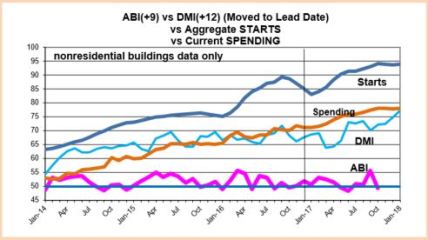
Overall Spending mostly correlates with Starts except that Starts showed a steeper growth rate in 2016 before a drop. Starts and Spending match well for all of 2014 and 2015. Both DMI and ABI are more erratic, however, the advances and declines in the ABI do correspond well with pickups and slowdowns in Spending. From mid-2015 through the end of 2016, the DMI was in a narrow range and that could possibly be said to be in synch with a slowed period of Spending.
Although they don’t match exactly by month, the ABI, DMI and Starts all show a drop sometime between 4th qtr 2016 and 2nd qtr 2017. That appears in Spending as a slight dip in 1st qtr 2017. The ABI gives an indication of a nice increase midyear. Both DMI and Starts are indicating substantial growth in spending by year end 2017.
Summary of 2017 Construction Outlook
2-21-17 This Summary is a collection of briefs pulled from all the articles that make up the 2017 Construction Outlook
Follow this for Link to Articles in 2017 Construction Outlook
NEW STARTS
Total of all Dodge Data & Analytics new construction starts for 2016 finished as the highest year since 2005. After 2016 totals get adjusted up we might see 2016 growth of 4% to 5% over 2015.
- Residential starts in 2016 posted the best year since 2005-2006. New starts show an increase of only 6% for 2016, but that follows several years of growth averaging more than 20%/year. I expect after adjustments 2016 residential starts will be revised to 8% growth.
- Nonresidential Buildings starts for the last six months averaged the highest since the 1st half of 2008. I expect after adjustment nonresidential buildings will show a 2016 increase of about 8% to 9%.
- Infrastructure starts even though posting a substantial decline for 2016 came in at the second highest year on record. 2015 was up 27% from 2014. I expect after adjustments the 2016 decline will be revised up by 3 points to -8%.
BACKLOG
The types, values and duration of projects that make up the backlog help get a clear picture of spending activity over time, particularly in the coming year.
Nonresidential buildings 2017 starting backlog is 45% higher than at the start of 2014, the beginning of the current growth cycle. Spending from starting backlog has increased every year and in 2017 it will be up a total of 35% over 2014.
SPENDING
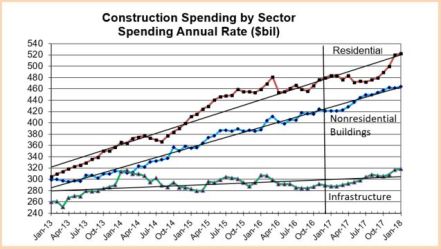
Total construction spending in 2017 will reach $1,236 billion, an increase of 6% over 2016, supported by a 4th consecutive year of strong growth in nonresidential buildings. The monthly rate of spending will range from near $1.2 trillion in January to $1.3 trillion at year-end.
- Nonresidential Buildings spending in 2017 will increase to $447 billion, 9.1% over 2016. Office spending will lead 2017 with 30%+ growth. Commercial, Lodging and Educational markets are all expected to post strong gains over 10%.
- Non-building Infrastructure, following two down years, will increase by 4.4% to $304 billion, due to growth in the highway and transportation markets.
- Residential will increase only moderately to $485 billion, adding 4.8% over 2016. That follows on three years of substantial growth averaging 17%/year.
- The entire construction industry best growth rate ever achieved (in constant 2016$) absorbed $1 trillion in new spending over 5 years. Infrastructure has not absorbed $1 trillion newly added work in 25 years.
- None of the starts or spending detailed above includes any projections of potential work from future stimulus.
PUBLIC CONSTRUCTION
The two largest components of Public Construction Spending, by far, are Highway/Bridge/Street and Educational Buildings. These two markets have more impact on the magnitude of public spending than any other markets.
Public Construction Spending average for the first six months of 2016 was the highest since 2010 and is up 10% from the Q4’13-Q1’14 low point.
Public spending finished 2016 down 0.8% from 2015, but that is down from a near six-year high, so spending is still strong. It is still 9% below its 2009 peak. Public spending in 2017 could increase more than 8%.
JOBS
For 2017, several economists (including myself) are predicting total construction spending will increase by just over 6%. However, I’m also predicting that combined construction inflation for all sectors will increase by 4.0% to 4.5%. That leaves us with a net volume growth of only 1.5% to 2.0%. Therefore, for 2017, we should not expect jobs to increase by more than 1.5% to 2.0%, or 100,000 to 140,000.
HOUSING
Housing Starts (# of units started as reported by U.S. Census) can be erratic from month to month and short term changes in growth can sometimes be misleading. Trends should be looked at over longer term periods. New monthly starts on a seasonally adjusted annual rate (SAAR) basis for the last eight months through January 2017 have now averaged over 1,200,000.
For the last four months housing starts have averaged an annual rate of 1,250,000, an increase of 8.5% over the range-bound average of 1,150,000 for the previous six quarters.
Housing starts for 2017 could surprise to the low side. Spending is predicted to grow 5%, but almost all of that is inflation. New starts could finish lower than the 65,000 in 2016.
MATERIALS
Most material prices have been muted over the last year, or even two years. Through the 3rd quarter 2016, material input prices had not registered a year over year gain for two years. In the last 4 months that has all changed. Steel, lumber and concrete are now all up in cost substantially over last year. Construction Input prices are up 4%. However, it is not material prices that have been driving inflation, which is up due to labor cost and market activity. Now material prices are also accelerating and that cold have a big impact on future inflation.
Final cost of materials averages perhaps 30% to 50% of building cost. The input cost of materials can contribute much less to overall project cost. For example a 10% cost increase in mill steel could add 0.4% to the total cost across all steel in a building. It could add 1% to the cost of a structural steel contract. A 10% increase in the cost of concrete, depending on if the building is a steel structure or a concrete structure, would add only 0.2% to 0.6% to the total cost of a building. A 10% increase in the cost of gypsum board would add less than 0.1% to the total cost of a building.
INFLATION
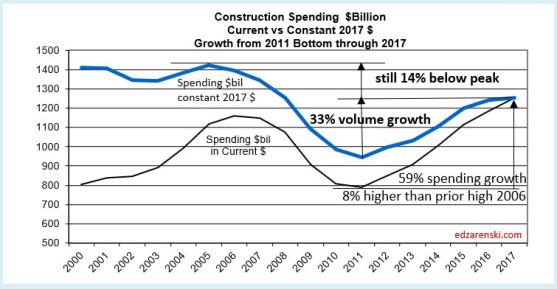
Constant $ adjusted for inflation converts all past spending into 2016$ for an equalized comparison. From the low point in 2011 we’ve increased spending by 48% but in constant 2016$ we’ve added only 29% in volume and we are still 16% below the 2005 peak. (updated plot 3-9-17)
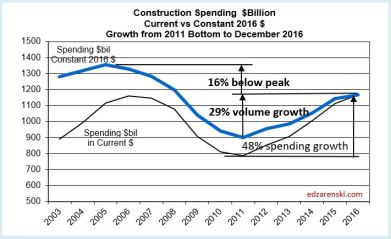
As measured in comparable constant dollars, No, we are not back to previous levels of construction spending. We will probably not return to previous highs before 2020.
- Long term construction cost inflation is normally about double consumer price inflation (CPI).
- Since 1993 but taking out 2 worst years of recession (-8% to -10% 2009-2010), the 20-year average inflation is 4.2%.
- Average long term (30 years) construction cost inflation is 3.5% even with any/all recession years included.
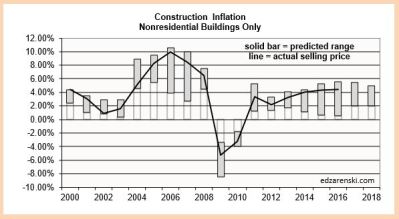
If you want to use a cost index to adjust project costs over time, you must understand what it measures. Selling Price, by definition, whole building actual final cost, tracks the final cost of construction, which includes, in addition to costs of labor and materials and sales/use taxes, general contractor and sub-contractor overhead and profit. Selling price indices should be used to adjust project costs over time.
Follow this link to 2017 Construction Outlook Compilation of Links to All Articles
2017 Construction Outlook Articles
Articles Detailing 2017 Construction Outlook
Links will open in a new tab
These links point to articles here on this blog that summarize end-of-year data for 2016 and organize in one place my projections for 2017.
Most Recently Published
Spending Summary Construction Forecast Fall 2017 12-3-17
Starts Trends Construction Forecast Fall 2017 11-8-17
Backlog Construction Forecast Fall 2017 11-10-17
Is Infrastructure Construction Spending Near All-Time Lows? 10-10-17
Construction Jobs / Workload Balance 11-2-17
Constant Dollar Construction Growth 11-2-17
Summary
Summary of 2017 Construction Outlook 2-21-17
1st Qtr Update 2017 Construction Spending Forecast 5-1-17
Construction Spending Midyear 2017 Summary 7-11-17
August Construction Spending 10-2-17
Spending Summary Construction Forecast Fall 2017 12-3-17
2016 Results
2016 Construction Spending 1-3-17
New Starts and 2017 Starting Backlog
New Construction Starts Totals for 2016 1-24-17
Starts Point to Robust 2017 Spending 10-20-16
ABI – DMI – Starts – Construction Spending 2-22-17
Construction Backlog Leading Into 2017 1-16-17
Construction Backlog 2017 3-20-17
Construction Starts and Spending Patterns 9-26-17
Starts Trends Construction Forecast Fall 2017 11-8-17
Backlog Construction Forecast Fall 2017 11-10-17
Spending Forecast
Forecast 2017 Construction Spending 1-7-17
Are We at New Peak Construction Spending? 1-4-17
Trends in Construction Spending 3-5-17
Construction Spending Almost Always Revised UP 5-1-17
Construction Spending May 2017 – Behind The Headlines 7-6-17
So, About Those Posts “construction spending declines…” 10-4-17
Ahead of the Sept Construction Spending Forecast 10-25-17
Nonresidential Buildings
Nonresidential Bldgs Construction Spending 2017 1-4-17
Office Buildings Lead 2017 Construction Spending 2-15-17
Nonresidential Bldgs 2017 Forecasts Vary 2-5-17
Nonres Bldgs Construction Spending Midyear 2017 Forecast 7-24-17
Residential
Housing Starts vs Residential Construction Spending 2-18-17
Infrastructure Outlook
Infrastructure Outlook 2017 1-12-17
Calls for Infrastructure Problematic 1-12-17
Infrastructure – Ramping Up to Add $1 trillion 1-30-17
Saturday Morning Thinking Out Loud #1 – Infrastructure 10-29-16
Is Infrastructure Construction Spending Near All-Time Lows? 10-10-17
Public Construction
Public Construction Spending 2016-2017 10-21-16
Infrastructure & Public Construction Spending 3-5-17
Jobs
Construction Spending vs Jobs 2-9-17
Behind The Headlines – Construction Jobs 2-16-17
Is There a Construction Jobs Shortage? 3-10-17
Construction Jobs Growing Faster Than Volume 5-5-17
Construction Jobs / Workload Balance 11-2-17
Inflation
How Much Does A Steel Cost Increase Affect Construction? 9-18-16
Constant Dollars – Impact of Inflation 2-4-17
Construction Inflation Index Tables UPDATED 8-6-17
Constant Dollar Construction Growth 11-2-17
2016 Construction Outlook Articles
Articles Detailing 2016 Construction Outlook
Links will open in a new tab
These links point to articles here on this blog that summarize end-of-year data for 2015 and point to articles with projections for 2016.
Most Recently Published
Summary of 2017 Construction Outlook 2-21-17
How Much Does A Steel Cost Increase Affect Construction? 9-18-16
2015 Results
Construction Spending 2015-2016 – How Do The Forecasts Compare? 12-9-15
Construction Spending 2015 and 2016 11-9-15
Construction Spending Market Performance of Nonresidential Bldgs 2015-2016 10-15-15
New Starts and 2016 Starting Backlog
Construction Backlog 2017 3-20-17
New Construction Starts Leading Into 2017 1-24-17
Behind The Headlines – Construction Backlog 1-16-17
Starts Point to Robust 2017 Spending 10-20-16
New Construction Starts Much Better Than Might Appear 9-23-16
Spending Forecast
Forecast 2017 Construction Spending 1-7-17
2016 Construction Spending year end 1-3-17
Are We at New Peak Construction Spending? 1-4-17
Construction Spending Gets Revised UP 10-6-17
Construction Spending 2016 – Midyear Summary
1st Quarter 2016 Construction Spending and Forecast
Construction Forecast 1st Look – What To Expect in 2016? 1-14-16
Erratic Pattern Ahead for 2016 Construction Spending. Why?
Nonresidential Buildings
Construction Spending 2016 – Midyear Nonresidential Markets
Updated 1-23-16 Forecasts of 2016 Nonres Buildings Construction Spending % Growth
Construction Spending Market Performance of Nonresidential Bldgs 2015-2016 10-15-15
Residential
Construction Spending vs Dodge Starts vs New Housing Unit Starts 4-27-16
Residential Work Flow From Housing Starts 4-25-16
Housing Starts > Look a Little Deeper 11-18-15
Claryifying Housing Starts Numbers 11-6-15
Residential Construction – Not All Data Tells The Same Story 10-25-15
Infrastructure Outlook
Infrastructure – Ramping Up to Add $1 trillion 1-30-17
Infrastructure Outlook 2017 1-12-17
Calls for Infrastructure Problematic 1-12-17
Saturday Morning Thinking Out Loud #1 – Infrastructure 10-29-16
Public Construction
Infrastructure & Public Construction Spending 3-5-17
Public Construction Spending 2016-2017 10-21-16
Jobs
Construction Spending vs Jobs 2-9-17
Behind The Headlines – Construction Jobs 2-16-17
Construction Jobs Show 3rd Qtr Growth 10-7-16
How Many Construction Jobs Needed to Support 2016-2017 Spending Forecast? 1-12-16
Inflation
How Much Does A Steel Cost Increase Affect Construction? 9-18-16
Construction Inflation Cost Index 1-31-16
 Construction Analytics