As expected, Construction PPI inputs inflation continues to creep up as the year goes on. Earlier this year Inputs to Nonres Bldgs Q1 avg growth was 3.6%. Q2 growth is 4.3%. Thru April, PPI was +3.5% compared to Dec’25. It’s now up 8.6%. Metals are up 12% to 20%. Diesel Fuel since Dec is up 100%.
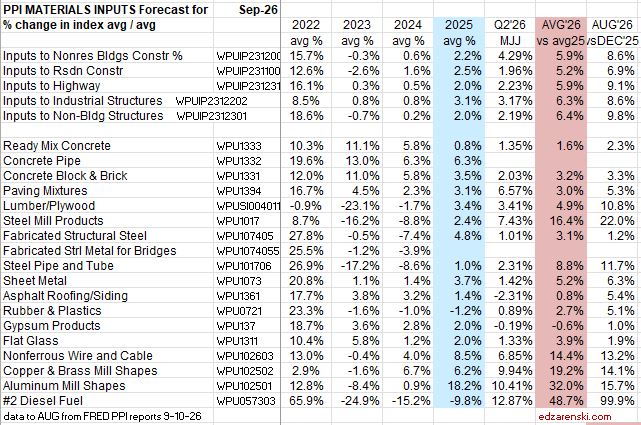
Final Demand PPI (as built final cost) has not yet caught up to the increases in inputs. I’d expect it to follow at least within 3 to 6 months. Final Demand cost growth is much more restricted than input costs. Contractors are restrained by contract limitations and cannot just increase expected final costs every month. Some added input costs will be recovered through negotiation. Some costs will be increased in subsequent bids.
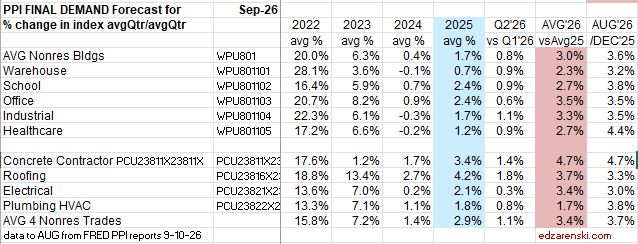
All five INPUTS to various types of construction, in both Q1’26 and then even higher in Q2’26, have posted the highest rate of inflation growth qtr/qtr for the past 15 qtrs (with only one single qtr exception). 2026 will most certainly post the highest rate of construction inflation since 2022.

Construction inflation decreased in each of the last 3 qtrs of 2024, then it increased in each qtr of 2025 and each of the 1st 2 qtrs of 2026. In the 1st 2 qtrs of 2026, construction inflation increased at the fastest rate since the 1st 2 qtrs of 2022 ( 1H-2022 was the fastest rate of growth in construction inflation this century).
For the last 6 months, construction inflation has increased at an average rate over 1%/mo, or an annualized rate over 12%/yr. All of that will not be passed on to the consumer immediately, but will eventually. So we can expect construction inflation growth to drag on well into 2027. Corporate business plans include a billing factor intended to recover the cost of capital expenditures over time. Any increased cost to the business is passed on to the consumer. So, eventually, the consumer (you and I) of products and services pays for the cost of inflation in construction.
Up to this point, all the above INPUTS reference only materials. There is labor to consider as part of inflation. Wages will not increase 12%. However, over the past year jobs increased by 1.5% and the volume of work produced fell 8.5%. So effectively, the cost of labor increased 10%, without even taking a wage increase into account.


This is a valuable resource for anyone interested in practical construction techniques and improving the quality of their building projects. The detailed approach to materials, measurements, and workmanship shows how careful planning can lead to better results.
LikeLike
I love these updates. I really wish you did water and sewer infrastructure cost tracking.
Thanks,
Michael Vinay
Director of Sanitary Sewer Services
County of Summit | Ilene Shapiro, Executive
The Russell M. Pry Building
1180 S. Main Street, Suite 201
Akron, OH 44301
LikeLike
Sewer and Water are reported in the spending tables, but not broken out separately. I do in fact have them reported separately in my files, just not published here. edz
LikeLike